
This is a level 2 measurement strand activity from the Figure It Out series.
A PDF of the student activity is included.
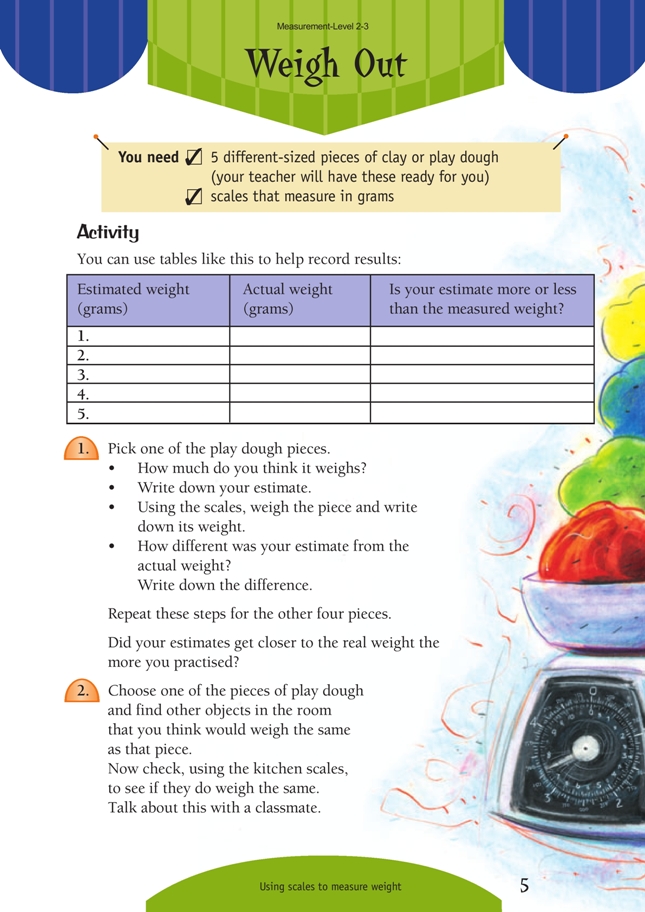
Click on the image to enlarge it. Click again to close. Download PDF (151 KB)
use scales to measure weight
FIO, Level 2-3, Measurement, Weigh Out, page 5
scales that measure in grams
This activity focuses on mass.
You will need to make up blocks of clay or play dough for this activity. Where possible, the pieces should be of different colours and have masses of about 100, 200, 300, 400, and 600 grams. This allows students to apply ratios when they are answering the questions, for example, “The red piece is about half the mass of the blue piece.”
This activity is aimed at students developing some benchmark masses from which they can estimate other masses. This is in keeping with the common practice of relating unfamiliar masses to known benchmarks, for example, “It’s slightly heavier than a 500 gram block of butter.” The students get better at estimating unknown masses as the activity progresses. Some may need leading questions, such as, “Before you estimate, how heavy is that piece compared to others you know about?”
Selecting objects of a mass similar to a selected piece opens up the concept of density. That is, the mass of an object is not just related to its size. For example, a piece of wood may be lighter than a smaller piece of steel. Aim for students to hypothetically balance the selected object and the piece of clay or play dough. Encourage them to check their judgment by weighing the object on a set of
scales. Students should explain differences between the expected and actual mass, for example, “The stapler looked heavy because it seemed to be made of metal, but most of it turned out to be plastic.”
Answers to Activity
Answers will vary.