
This is a level 4 number activity from the Figure It Out series. It relates to Stage 7 of the Number Framework.
A PDF of the student activity is included.
Click on the image to enlarge it. Click again to close. Download PDF (439 KB)
use place value blocks to show knowledge of decimal place values
FIO, Level 3-4, Number, Book 1, Waves Win, page 8
Place value blocks or multilink cubes
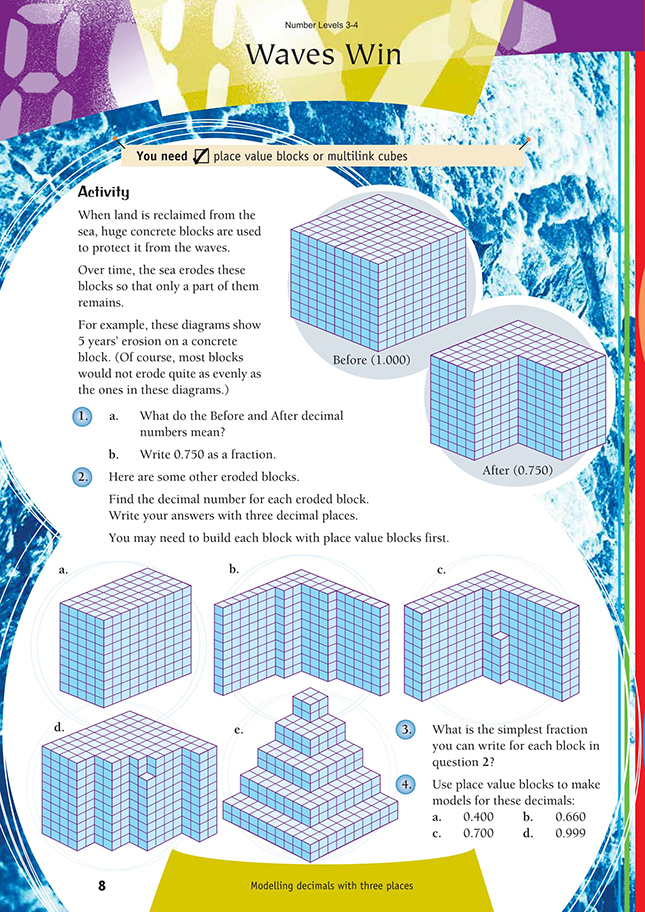
Some students may need to use place value blocks or multilink cubes to help them with the visualising and counting in this activity. Those students with better visualisation skills will probably cope without using blocks or cubes, but these should be available to them, especially in questions 2c and d.
Remember that the decimals come from comparing the number of blocks left in the given shape with those in the whole.
The students need to know the number of smaller blocks in the original. Get them to count the number remaining and write this as a decimal fraction of the whole. This may require converting fractions to decimals. Some students may be able to visualise the fraction for some of the blocks.
Answers to Activity
1. a. The 1.000 means that the concrete block is a whole unit, with no erosion. The 0.750 means that the erosion has been 0.250, or 25%, leaving 75% of the block still there.
b. 750/1000 (this means 750 ÷ 1 000, which in its simplest form is 3/4)
2. a. 0.500
b. 0.250
c. 0.375
d. 0.718
e. 0.440
3. a. 1/2
b. 1/4
c. 3/8
d. 359/500
e. 11/25
4. Teacher to check