This is a Level 2 Geometry activity from the Figure It Out Series.
A PDF of the student activity is included.
Click on the image to enlarge it. Click again to close. Download PDF (174 KB)
predict rotation patterns
Cardboard (optional)
Scissors (optional)
Activity One
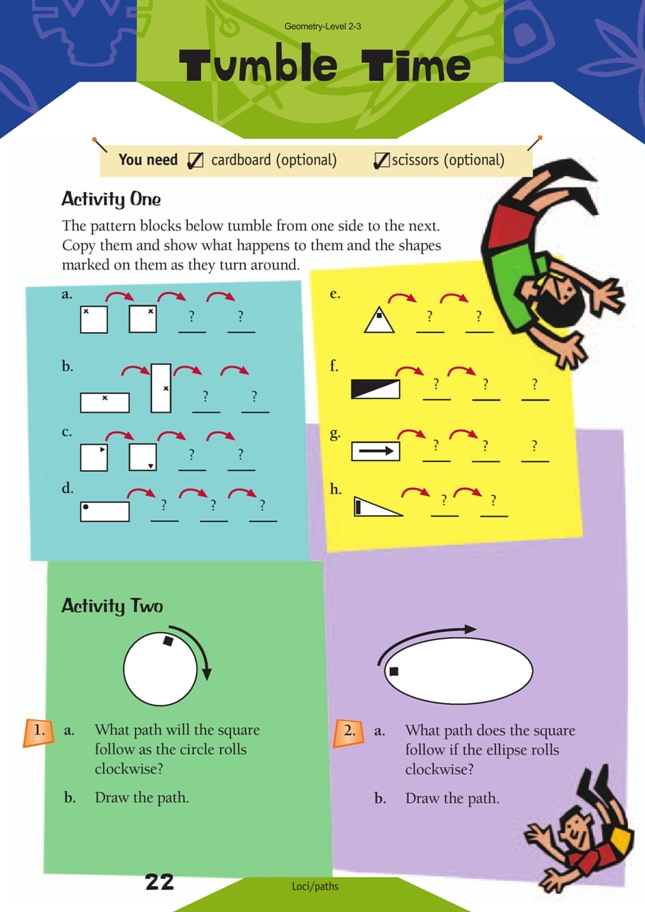
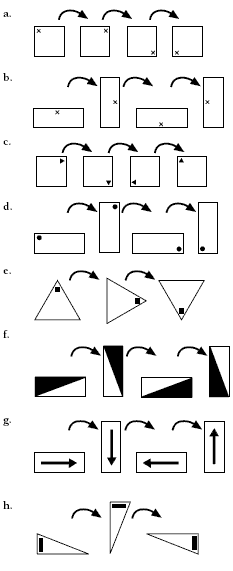
The aim of the activity is to have students visualise the movement of well-known shapes and get them to focus particularly on the path (locus) of a point or area at a fixed position on the shape.
For example, the path of the point on the cube-shaped block in diagram a would be:
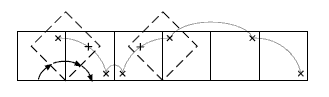
Encourage the students to attempt to draw the path of the marked point or area following successive quarter-turns in the case of quadrilaterals and third-turns in the case of the equilateral triangle.
Students can confirm their answers by making a two-dimensional model of each block from card and turning it along a ruler edge (as shown below).
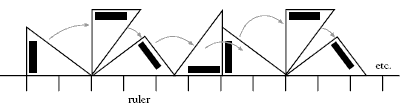
Another way to find the path of a point is to bore a small hole in the card and use the end of a pencil to trace the curve as the whole shape is turned.
Activity Two
The curved path traced by a point on the outer edge (circumference) of a circle as it turns is called a cycloid. Again, students can model this curve by cutting a circle from card and tracing the path of the point through a small hole. Encourage them to sketch what they think the curve will look like before experimenting:

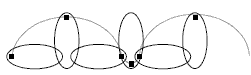
The curve traced by a point on the circumference of an ellipse has similar characteristics, though the height of the curve depends on the location of the point. Once again, this characteristic is easily explored with a cardboard ellipse (see the diagram in the Answers section).
Answers to Activities
Activity One
Activity Two
1. a. It moves in a circular path as the circle turns.
(It stays in the same position in relation to the outside of the circle.)
b.
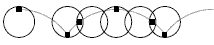
2. a. The square in the ellipse will also move in a
circular path (because the square is always
the same distance from the centre of the
ellipse).
b.