
This problem solving activity has a number (multiplication and division) focus.
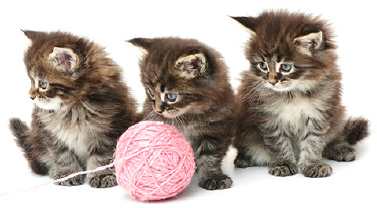 Mother Cat is making mittens for her three cold kittens.
It takes two balls of wool to make mittens for one kitten.
How many balls of wool will Mother Cat need to make mittens for three little kittens?
If one ball of wool costs $2, how much money will the three sets of mittens cost to make?
- Count groups of two.
- Use equipment to model and add sets of twos.
This problem involves repeated addition or skip counting in twos. These strategies underpin multiplication.
- Copymaster of the problem (English)
- Copymaster of the problem (Māori)
- Model/pictures of kittens and wool balls
- Counters, play money
The Problem
Mother Cat is making mittens for her three cold kittens. It takes two balls of wool to make mittens for one kitten. How many balls of wool will Mother Cat need to make mittens for three little kittens?
If one ball of wool costs $2, how much money will the three sets of mittens cost to make?
Teaching Sequence
- Introduce this problem by reading the poem "3 little kittens who lost their mittens" (available online).
- Pose the problem to the class.
- Ask the students to identify the important information given in the problem. Highlight the key terms in the problem.
- Brainstorm for ways to solve the problem and record their solutions. Students could use the counters to represent the wool balls, and could draw the kittens.
- As the students work on the problem, ask them to explain the strategy they are using:
Tell me what you are doing?
How is that helping you solve the problem?
How many mittens could you make with those balls of wool? - Share the solutions.
Extension
Vary the number of kittens, balls of wool per set of mittens, and/or cost of each ball of wool. The solution will be dependent on the numbers used.
Solution
Students will record their solutions in a variety of ways. Six balls of wool are needed.
Three sets of mittens will cost $12. Students may use play money or other materials such as counters to model this.