
This problem solving activity has an algebra focus.
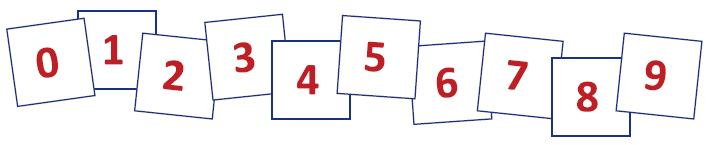
Jim has ten tiles with a different digit on each of them.
He plays around and discovers that he can make quite a lot of ten-digit numbers that are divisible by ten by using the tiles.
In fact how many can he make?
- Identify numbers divisible by 10.
- Count large but relatively straightforward sets.
- Devise and use problem solving strategies to explore situations mathematically (be systematic, think, use a simpler case, draw a digram).
This problem investigates numbers with a given factor. Students must first be able to identify the property of a number to determine its factors. For example: a number is divisible by 10 if its last digit is 0.
Students must then be able to count in an efficient manner all the numbers with this property. Using a tree diagram with a simpler case is a suggested strategy.
This is the first of a series of three Algebra problems: Ten Tiles I, Level 5; Ten Tiles II, Level 6; and Ten Tiles III, Level 6. The Level 3 Number problem At The Movies is a useful starting place for this problem.
- Copymaster of the problem (English)
- Copymaster of the problem (Māori)
- Ten tiles with numbers 0 to 9 (Pieces of paper will suffice)
The Problem
Jim has ten tiles with a different digit on each of them. He plays around and discovers that he can make quite a lot of ten-digit numbers that are divisible by ten by using the tiles. In fact how many can he make?
Teaching Sequence
- Use a classroom discussion to revise the idea of factors and how you can identify numbers that have given factors.
What are the factors of 24? 36?
What does it mean to say that 35 is divisible by 7?
How do you know if a number is divisible by 2? 10? 5? - Pose the problem. Provide the cards for students to use when creating the ten-digit numbers.
Can you give me a number that is divisible by 10?
Can you give me a ten-digit number that is divisible by 10?
How about a ten-digit number that contains each of 0, 1, 2, 3, 4, 5, 6, 7, 8, 9? - As students begin to work on the problem in their groups ask:
How many numbers can you make using just one 0, 1 and 2, that are divisible by 10?
How about if we use 0, 1, 2, 3 just once each? How many then?
Can you see a pattern here? - As solutions emerge, have students share and explain their approaches. Some students might begin on the extension problem.
- Have the students record their solutions.
Extension
Jessica looks at Jim’s tiles. She sees that she can work out how many two-digit numbers she can make using these tiles, that are divisible by two. How many can she make with Jim’s tiles?
Solution
Ten-digit numbers divisible by ten: Such a number has to have a zero in the last place. Then there are 9 x 8 x 7 x 6 x 5 x 4 x 3 x 2 x 1 = 362880 ten-digit numbers that are divisible by ten. This is because there are 9 possible digits than can be used first. Once that is used there are 8 digits left. For any of the first 9 numbers there are 8 choices for the next number. That gives 9 x 8 = 72 possibilities so far. The pattern continues (see also At The Movies.)
Solution to the Extension
For any number to be divisible by two the last digit has to be even. Here we have the choice of 0, 2, 4, 6 and 8. This gives us 5 choices. But we now have difficulties. Things are different if 0 is the last digit. For instance, if 5 is the last digit then we have to make sure that 0 is not the first digit. So we have to split the problem into two parts. On the other hand, we don’t have this worry if 0 is the last digit.
If 0 is the last digit, then there are 9 choices for the tens digit.
If 2, 4, 6 or 8 is the last digit then there are 8 choices for the tens digit (10 minus the 0 and minus whatever digit was used in the units position). This gives 4 x 8 = 32 numbers.
Altogether there are 41 even two-digit numbers.
This can be done by first allowing 0 to be the first digit and then counting how many times 0 is the first digit. We can then subtract the second number – 4 - from the first - 45 – to give the answer of 41. This problem can also be solved using a tree diagram.
This problem can also be solved by writing out all possibilities and then counting the result. If a student does it this way that is fine. You might suggest a more efficient method.