
The unit uses the poem “Ten in the Bed” as a context for the students to begin to explore patterns in number and patterns within texts.
- Identify a number pattern.
- Identify repeating patterns in texts.
- Guess and check for the next number in a pattern.
- Predict "what comes next" based on the understanding of the pattern in number and text.
This unit looks at some simple number patterns. The work completed in this unit is the kind that helps to provide a foundation for all future pattern work and hence for algebra proper. The key things that the students should learn are that:
- a pattern involves a continual repetition in some way
- the next term in a pattern can be guessed
- that this guess should be checked
As the students go further up the levels they will see that it is possible to formally write down expressions to show how to go from one term in the pattern to the next. They will also see how to find formulae for step (ii).
The learning opportunities in this unit can be differentiated by providing or removing support to students and by varying the task requirements. Ways to support students include:
- providing more opportunities to work with the sequence of numbers to five before working with numbers to ten, for example, investigating five in the bed, five in the bus and five in the waka before looking at the sequence to 10
- providing more opportunities to work with patterns of two before moving onto patterns with other numbers.
The contexts for this unit can be adapted to suit the experiences of your students. For example:
- using context other than 10 people in the bed, for example, 10 people on the waka, 10 people sleeping at the marae, or 10 chickens in the backyard.
Te reo Māori vocabulary terms such as tauira (pattern) and tarua (repeat) as well as counting from kore ki tekau (zero to 10) could be introduced in this unit and used throughout other mathematical learning. Other te reo Māori vocabulary terms that could be useful for this unit are moenga (bed), karu (eyes), kihi (kisses) and matimati (toes).
- A hard copy or digital version of the poem "Ten in the Bed". A picture book version (written by Penny Dale) may be available in your local or school library.
- Chart paper and pen
- Counters, cubes, pencil and paper
Session 1
Here we share the story and construct a pattern grid from the story. This pattern grid will be used throughout the sessions. It could be created with paper or with the use of digital tools (e.g. Google Slides).
- Share “Ten in the Bed”.
- With the help of the class, rewrite the poem so that the initial character is calling others to bed. There was one (tahi) in the bed and the little one said,
“Come to bed, come to bed”
There were two (rua) in the bed and the little one said
“Come to bed, come to bed.” - As the poem is compiled, record what is happening in pictorial form and also record the total number of children in bed each time on the pattern grid (see one completed under step 8 below). For example:
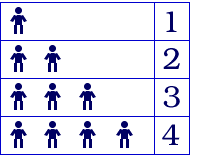
- Encourage the students to predict the next number each time. Students might use counters to demonstrate the addition of each new person.
What is happening?
Who can see a pattern in the pictures?
What is that pattern?
Who can see a pattern in the numbers?
What is that pattern? - As a class, continue to construct the grid up to five in the bed. As you record the poem encourage students to predict and repeat the parts of the text that form the pattern. These can be highlighted in a particular colour for emphasis. What is the same about the next page? What words will need to change?
- How many will be in the bed next?
Students make predictions and are then asked to go and check their answers using paper and pencil or objects. - Students continue until there are 10 children in the bed.
- Volunteers share their solutions.
What did you do to find the answer?
Did someone do it another way? The chart and book are compiled up to ten and both are displayed for the students to explore further (See pattern grid below.)
Number of jumps into bed 1 2 3 4 5 6 7 8 9 10 Number of children 1 2 3 4 5 6 7 8 9 10
Session 2
Here we focus on the number of eyes in the bed to build up a pattern that goes up two at a time. If your students are confident using English and te reo Māori words for numbers, you could incorporate words for numbers from any other languages reflected in the makeup of your class. This should be appropriate for your learners, so as not to add too much additional cognitive loading.
- Share the poem and the chart compiled in the previous session. Focus on the pattern and how the students knew what was coming next.
- If there was one (tahi) person in the bed how many eyes would we see?
- Select students to act out the problem.
- If there were two (rua) people, how many eyes would there be?
What did you do to work it out?
Record the number of eyes the same way as in the previous session. - Continue the story up to four (wha) people in bed. Record what has happened on the chart.
- What is happening on our chart?
Look at the picture of the eyes. What is happening each time?
Look at the numbers. What is happening here each time? - The students are asked to continue the pattern to find out how many eyes there would be in the bed if there were ten in the bed. They are able to use pencil and paper, counters, or cubes.
- Students come back to the whole class setting to share their solutions.
What did you do? Why did you do that? Did someone do it another way? The class jointly completes the chart (See below.)
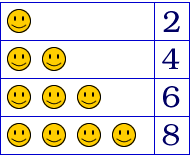
Number of jumps into bed 1 2 3 4 5 6 7 8 9 10 Number of eyes 2 4 6 8 10 12 14 16 18 20
Session 3
Here we explore a pattern that increases by five and record it on a pattern grid.
- Reread the new version of “Ten in the Bed.”
Tell the class that each evening their mother comes in to give the children a goodnight kiss. She gives each child five kisses. Record this information for one child on a chart using pictures and numbers.
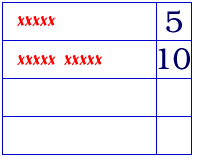
Number of children kissed 1 2 3 4 5 6 7 8 9 10 Number of kisses 5
- How many kisses would mum give if there were two in the bed?
How could we find out?
Record the answer on the chart. - Repeat for three in the bed.
How many kisses will mum give now? - Examine the chart.
Can anyone see a pattern in the picture?
Is there a pattern in the numbers?
Can we use this pattern to work out how many kisses mum will need to give if there are five in the bed? Seven in the bed? - Students solve the problems then return to a whole class setting.
- What answers did you find?
What did you do to find the answer?
Why did you do this?
Could we do it another way?
How did you use the pattern to help you find the answer?” - The class jointly completes the chart by first using the solutions the students already have and second by predicting and then confirming using the pattern that they have seen.
Session 4
The students explore patterns of ten using toes as a focus.
- Read through previous days’ charts, drawing attention to the picture and number patterns. As a class, you could act, or use puppets, to demonstrate the patterns.
- Today we are going to find out how many toes there might be in the bed. If there was one child in the bed we know there would be ten toes.
Does anyone know how many toes there would be if there were two children in the bed?
How did you work that out? - Using equipment or pencil and paper the students explore patterns of ten until they are able to say how many toes there would be with up to ten children in the bed. Support students, who are not yet confident with writing numbers, as necessary.
- Students share their thinking and solutions with the class.
Session 5
The students design questions around “Ten in the Bed” for their class to solve.
- We have been exploring patterns from the poem "Ten in the Bed".
We have looked at patterns of eyes, kisses and toes.
Today you are going to make up your own questions about our story for the class to solve.
(You may need to discuss this with them before they start on their own.) - Students write problems that involve exploring patterns in the poem. Consider the writing abilities of your students. It may be wise to provide sentence starters for some, or all, of your students (e.g. there were 10 tamariki in the playground…how many…?). Alternatively, you may write one story as a class, and then pair up students to write questions relating to this story. This story should be relevant to current learning from another curriculum area (e.g. learning about minibeasts), to the wider context of your class (e.g. a class trip to the museum), or to a collective interest demonstrated by your students (e.g. animals).
- Students swap problems and solve each other's problems.
- Students share their problems and solutions with the class.
Dear parents and whānau,
This week in maths we have been exploring number patterns by looking at the poem “Ten in the Bed”. Ask your child to tell you the poem.
Suppose that each child had two teddies.
How many teddies would be in the bed if there was one child in the bed?
How many teddies would be in the bed if there were two children in the bed?
How many teddies would be in the bed if there were three children in the bed?
Keep going up to ten children.
We have made a chart (below) to show the pattern. You could make an empty chart like this and fill it in with your child as you go. See if your child can guess what number of toys is going to come next. Then check that the guess is correct.
| Number of children in bed | 1 | 2 | 3 | 4 | 5 | 6 | 7 | 8 | 9 | 10 |
Number of teddies | 2 | 4 | 6 | 8 | 10 | 12 | 14 | 16 | 18 | 20 |
Try it again with a new chart and a different number of teddies.
Enjoy encouraging your child to see number patterns.