
These are level 4 measurement and algebra problems from the Figure It Out series.
A PDF of the student activity is included.
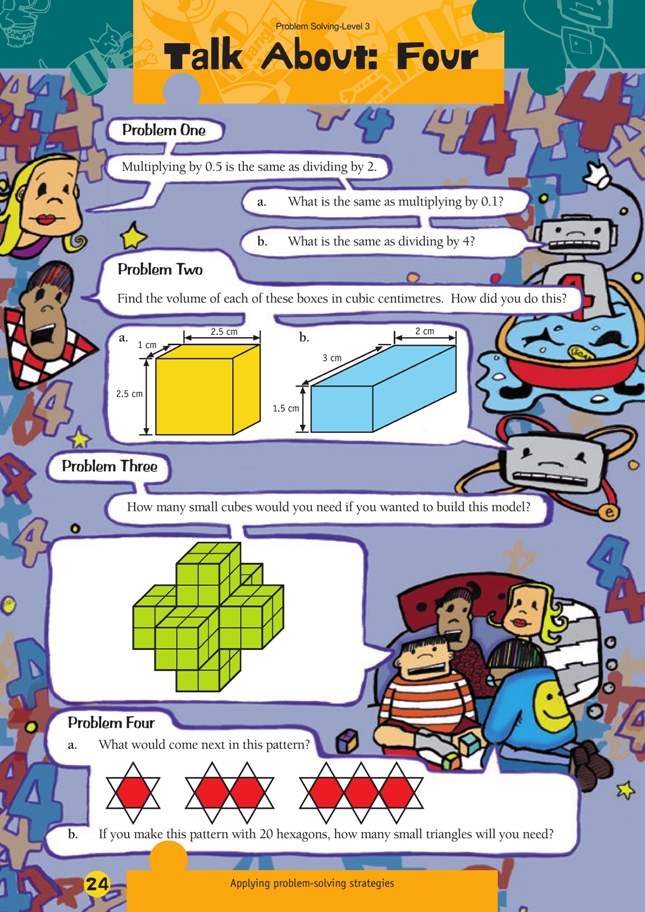
Click on the image to enlarge it. Click again to close. Download PDF (283 KB)
find volume of a cuboid (Problems 2 and 3)
solve problems involving sequential patterns (Problem 4)
Problem One
Through this problem, students explore the idea of reciprocals. One is its own reciprocal because dividing by one has the same effect as multiplying by one.
Students will need to discuss what multiplying by a decimal less than one means. Multiplying by 0.5 is the same as finding a half of something. So 0.5 x 2 = 1 (because 1 is a half of 2), 0.5 x 10 = 5, and 0.5 x 18 = 9. Finding a half is the same as dividing by two.
Multiplying by 0.1 is the same as finding a tenth of something. So 0.1 x 3 = 0.3 (because one-tenth of three is three-tenths) and 0.1 x 15 = 1.5 (because one-tenth of 15 is fifteen-tenths, which is 1.5). Finding 0.1 of something is the same as dividing by 10.
Dividing by four is like finding a quarter of something. Since 0.25 = 1/4, multiplying by 0.25 has the same effect as dividing by four. For example:
8 x 0.25 = 2 8 ÷ 4 = 2
24 x 0.25 = 6 24 ÷ 4 = 6
Problem Two
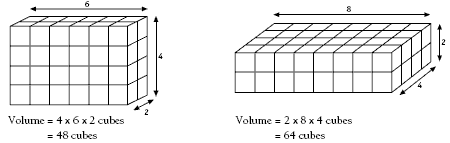
Finding the volumes of the cuboids shown is more difficult than previous problems involving whole numbers of cubes. Students will need to generalise the method for calculating the volume of a cuboid (length x width x height).
Many of them will need to go back to cube models to realise this:
The boxes shown on page 24 of the students’ booklet have no lines to mark cubic centimetres. Putting these in may help some students visualise the dimensions of each cuboid.
Counting the cubes and parts of cubes verifies that multiplying the sides gives the volume: 2.5 x 2.5 x 1 = 6.25 cm3.
Similarly, the volume of the other cuboid can be found. (See Problem One on page 18 of the students’ booklet.)
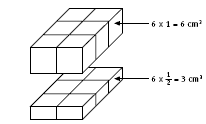
Volume = 1.5 x 2 x 3 = 9 cm3
Problem Three
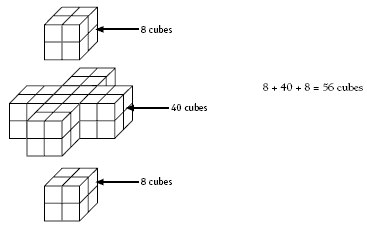
Encourage students to visualise the model without using cubes to build it. Students will have a variety of methods for working out the number of cubes in the model. For example:
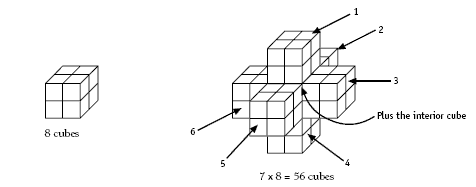
Alternatively, the model can be divided other ways:
Problem Four
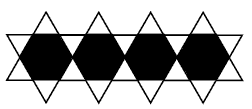
This problem involves continuing a sequential pattern. Students can model it with hexagonal and triangular pattern blocks. As students build the pattern, they will see that for each new hexagon added, four triangles are added.
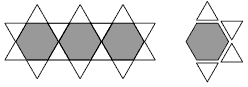
This can also be shown in a table: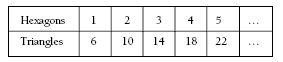
The table could be extended to 20 hexagons by adding four triangles each time.
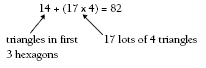
Students who see repeated addition of four as multiplication by four will find more efficient ways to solve the problem, such as:
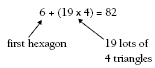
- 6 + (19 x 4) = 82
Answers to Problems
1. a. Dividing by 10 is the same as multiplying by 0.1.
b. Multiplying by 0.25 is the same as dividing by 4.
2. The volume of box a is 2.5 x 2.5 x 1 = 6.25 cm3
and the volume of box b is 1.5 x 2 x 3 = 9 cm3.
To find the volume, multiply the height by the width by the depth.
3. 56 cubes
4. a.
b. 82