
This is a Level 2 Geometry activity from the Figure It Out Series.
A PDF of the student activity is included.
Click on the image to enlarge it. Click again to close. Download PDF (293 KB)
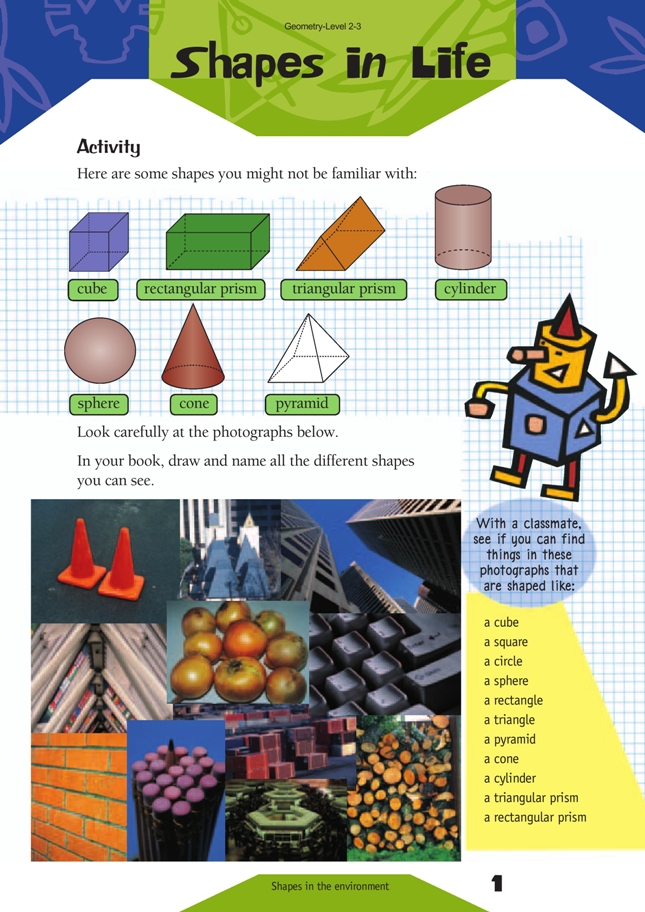
identify two dimensional and three dimensional shapes in the environment
Students should not have too many difficulties finding the two-dimensional shapes (squares, circles, triangles, etc.) in the photographs. However, before they attempt to identify the solids in the pictures, it is wise to discuss the features of these solids. They can be classified into two broad categories:
The important features of polyhedra are the number and shape of their faces, the number of edges, and the number of vertices (corners). For example, a cube has six square faces, 12 edges, and eight vertices.
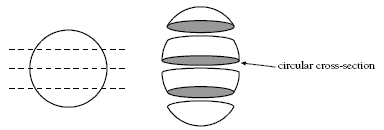
Closed surfaces are formed by the intersection of surfaces that may be flat or curved. Cross-sections of closed surfaces are interesting and can be explored by making the solids with play dough and cutting them with one straight cut. For example, no matter where you cut a sphere, its cross-section is always a circle, (though it can be argued that the cut could touch the circle at one point):
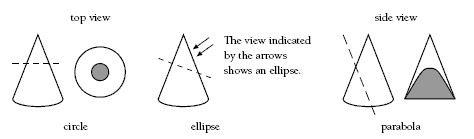
A cone has many well-known cross-sections:
Answers to Activity
Answers will vary.