
This problem solving activity has a geometry focus.
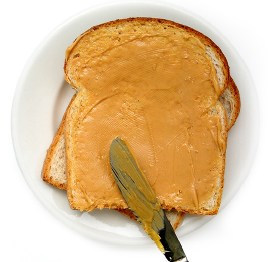
Ngawai and Tom make a peanut butter sandwich.
How can they share it fairly?
Can you find three different ways to cut the sandwich?
- Divide a region into two equal parts through folding or cutting.
- Demonstrate that the two parts are equal and describe these parts as halves.
This problem is about finding equal parts of a whole. A whole can be described as a region or a unit. When there are two equal parts, each is a half. To succeed at this problem, students should have experiences of seeing and manipulating halves of different sized and shaped regions.
The cuts in this problem have to be made so that each piece is exactly the same as the other. You may need to simplify the problem, in the first instance, by imagining that the loaf of bread has a rectangular cross-section.
Encourage the students to find as many ways of solving this problem as they can.
- Picture of a sandwich (or a real sandwich) (to introduce the problem)
- Rectangular pieces of paper
- Copymaster of the problem (English)
- Copymaster of the problem (Māori)
The Problem
Ngawai and Tom make a peanut butter sandwich. How can they share it fairly?
Can you find three different ways to cut the sandwich?
Teaching Sequence
- Introduce the problem using a sandwich or picture and two students from the class.
- Ask the students to all think of one way that they could share the sandwich. Share one idea.
- Read the problem to the class.
- Solve the problem in pairs. As the students work, ask questions that focus on the meaning of a ½. Allow the students to describe their ideas. Encourage explanations.
How do you know the parts are equal?
Are you happy with your share? Why?
Can you think of other ways to share it?
Tell me about your thinking?
How are you keeping track of the ways that you find? - Ask that the students keep a record of the different ways that they find to share the sandwich.
- Share solutions.
Extensions
- Imagine a loaf that does not have a square cross-section.
- Use 4 students instead of 2.
- Share a bag of 8 lollies between Ngawai and Tom.
- Share an item with a circular region (e.g. a cookie).
Solution
There are, in fact, an infinite number of solutions. As long as you cut or fold through the centre point of the rectangle the parts will be equal. Some examples of single cuts or folds are:
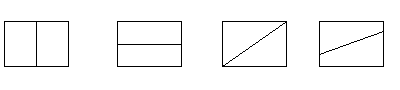
In order to see that all of these cuts do give equal parts, you could cut out the halves and put them one on top of the other, or use digital images with the level of transparency increased (e.g. on PowerPoint). This may require rotation in some cases. This may provide the opportunity to explore some of the transformation ideas from the Geometry Strand.
If the bread has a cross-section that consists of a rectangle with a semi-circle on top, then there is only one simple solution to the problem by making a vertical cut. There must be another solution by cutting parallel to the base of the rectangle (the side opposite the semi-circle) but it is extremely difficult to find the exact point to make this cut.
Solution to the Extension
The solutions are dependent on the shape of the loaf.
If 4 students share one sandwich they will each get 1/4. Demonstrate different ways of dividing the sandwich picture into quarters.
If Ngawai and Tom share 8 lollies they will each get 4 lollies.
Model dividing an item with a circular region into halves and quarters. Demonstrate folding to find the centre and drawing straight lines.