
These are level 2 number and geometry problems from the Figure It Out series.
A PDF of the student activity is included.
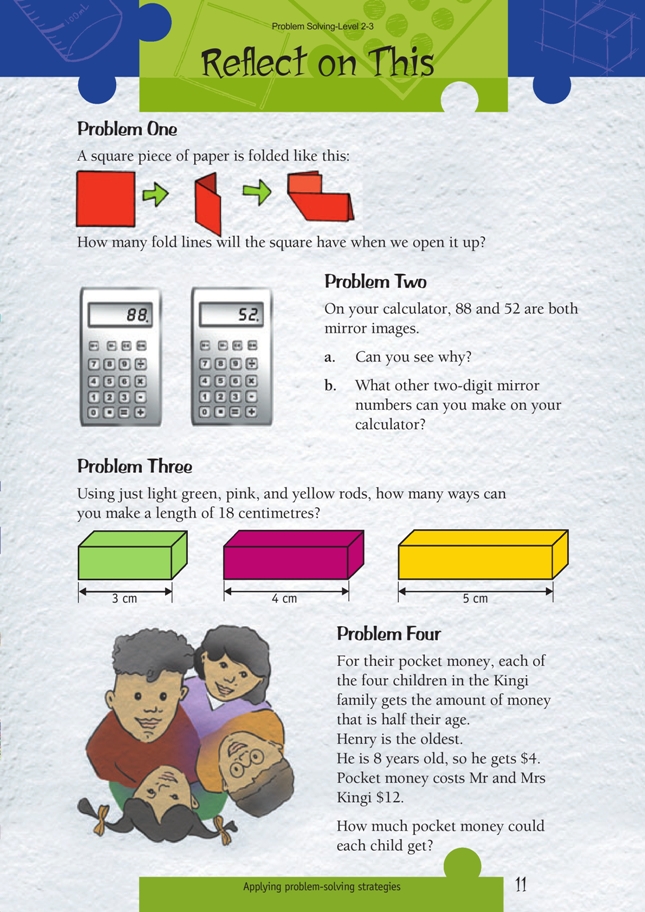
Click on the image to enlarge it. Click again to close. Download PDF (331 KB)
explore reflection patterns (Problems 1 and 2)
use additive strategies to solve problems (Problems 3 and 4)
Problem One
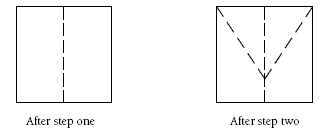
Encourage the students to predict the number of fold lines as they follow the fold instructions. They may be able to draw where they think the fold lines will be after each step, and this can be confirmed by unfolding the square:
Visualisation is very difficult, so the students need experience with simpler examples, such as:
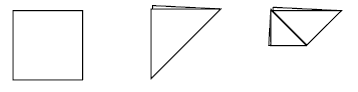
How many fold lines?
Students may also like to make up simple fold problems for someone else.
Problem Two
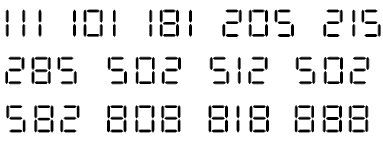
Students will need to identify mirror relationships between the digits.
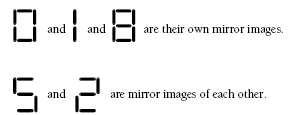
No other mirror relationships exist. This limits the number of two-digit mirror numbers to:

This knowledge can be applied to finding the different three-digit mirror numbers.
Problem Three
A systematic approach will be needed to find all the possibilities. This might begin with all the possibilities involving any green rods:
Six green rods (6 x 3 = 18)
Three green rods, one yellow rod, one pink rod (3 x 3) + 5 + 4 = 18
Two green rods, three pink rods (2 x 3) + (3 x 4) = 18
One green rod, three yellow rods 3 + (3 x 5) = 18
Students can then find all the possibilities that can be made without using green rods:
Two yellow rods, two pink rods (2 x 5) + (2 x 4) = 18
Students might go on to investigate how many ways a length of 24 centimetres could be made with the three different-coloured rods.
Problem Four
If Henry’s pocket money is removed from the $12 total, that leaves $8 to be shared among the remaining younger children. There are several possible combinations, which can be found in an organised way (see the Answers section).
Note: If Henry is the elder by birth of twins, that opens up other possibilities, such as ages 4, 4, 3, 1 or 4, 4, 2, 2.
Students may enjoy making up their own problems about children’s ages.
Answers to Problems
1. 3
2. a.

b. 25, 11
3. 1 green and 3 yellow
2 green and 3 pink
3 green, 1 yellow, 1 pink
6 green
2 yellow and 2 pink
4. Some possibilities:
$4, $3.50, $3.50, $1
$4, $3.50, $3, $1.50
$4, $3.50, $2.50, $2
$4, $3, $3, $2
$4, $3, $2.50, $2.50