
This is a level 2 number activity from the Figure It Out series. It relates to Stage 5 of the Number Framework.
A PDF of the student activity is included.
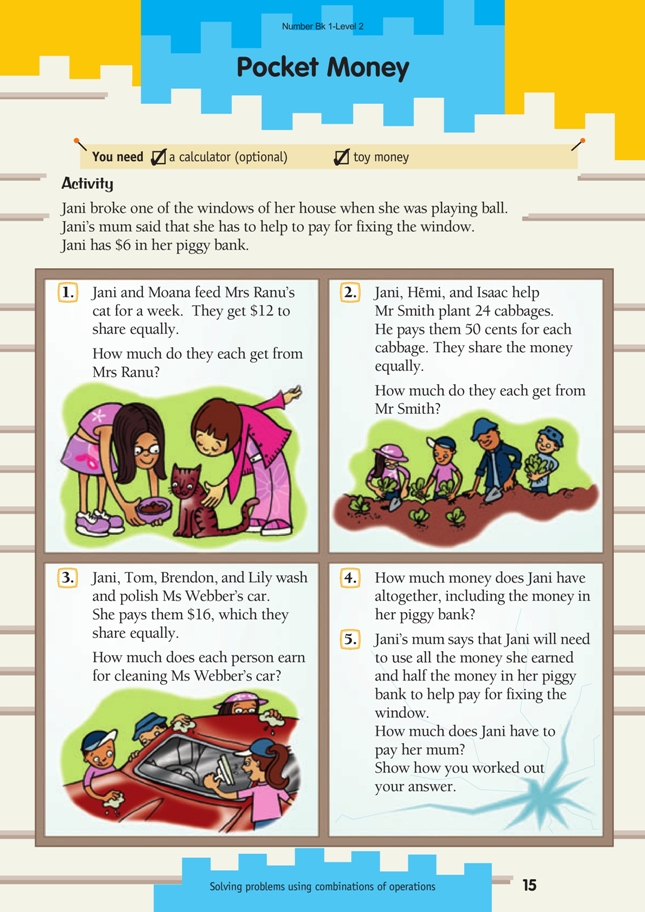
Click on the image to enlarge it. Click again to close. Download PDF (243 KB)
solve story problems involving sharing
FIO, Level 2, Number, Book 1, Pocket Money, page 15
Toy Money
These problems can be solved in a variety of ways, and the students might use a mixture of the four arithmetic operations to find the solutions.
The students who recognise the connection between sharing equally between two and halving might use their recall of doubles and halves to answer question 1. To help highlight the different ways of talking about halving, the students could brainstorm the various expressions for half, that is, halving, divide by 2, share equally between two, ÷ 2, find 1/2 of.
Acting out the problems using toy money will provide the support that some students need. They could use a calculator as well as their mental strategies and compare their solutions with the answer on the calculator. They need to be able to explain how they got their answers, however. To use the calculator efficiently, the students need to be familiar with the “divide by” sign. If they use the calculator for question 2, the students will probably key in 24 x 50 = and arrive at a solution of 1 200. Ask them “1 200 what?” You may need to remind them that the context is cents. If they do not have the place value understanding to interpret 1 200 cents as $12, using the toy money will help them.
As an extension, you could say to the students “The window cost $30 to fix. How much did Jani’s mum pay?”
Answers to Activity
1. $6 ($12 ÷ 2 = $6)
2. $4 (24 x $0.50 = $12 and $12 ÷ 3 = $4 or 24 ÷ 3 = 8 and 8 lots of 50 cents is $4)
3. $4 ($16 ÷ 4 = $4)
4. $20 ($6 + $6 + $4 + $4 = $20)
5. $17 (Earned: $6 + $4 + $4 = $14, half money in piggy bank: $6 ÷ 2 = $3, $14 + $3 = $17)