This is a level 4 geometry strand activity from the Figure It Out series.
A PDF of the student activity is included.
Click on the image to enlarge it. Click again to close. Download PDF (352 KB)
explore angle properties of two dimensional shapes
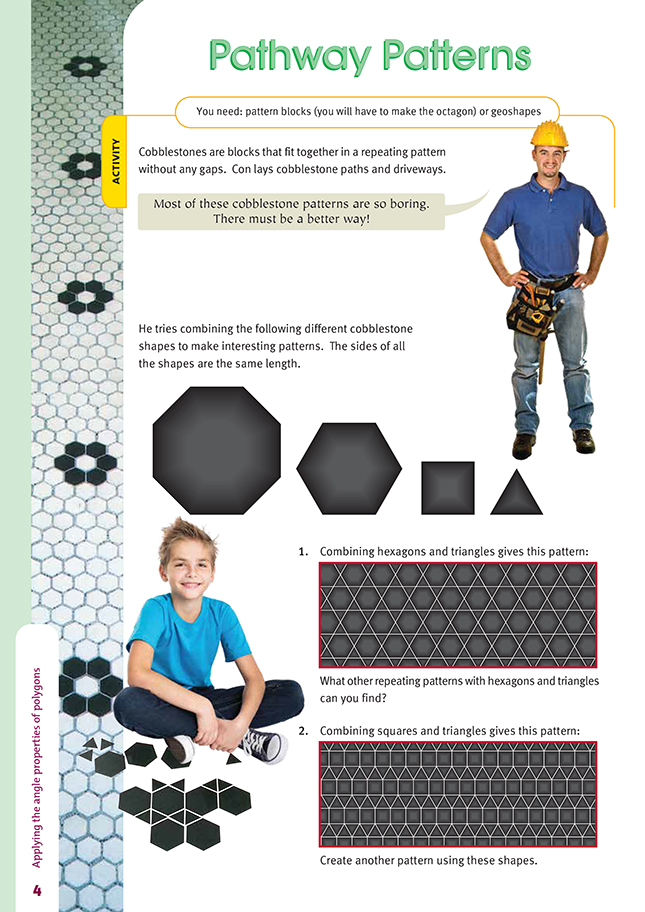
FIO, Level 4, Geometry, Book One, Pathway Patterns, page 4
pattern blocks (to make a octagon) or geoshapes
Tessellations can be found everywhere: in brick or concrete block walls, fences, and floor and wall tiles, on vinyl, carpet, and wallpaper, and in paving stones and cobblestones. The hexagonal honeycomb is an example from nature. Many of M. C. Escher's prints also feature tessellations. (See Escher Envy in Geometry:
Book Two, Figure It Out, Years 7-8).
To do this activity, the students will need a good supply of the four regular shapes. If necessary, they can cut out their own. (The octagon is not a standard pattern block.) If they do this, they need to make sure that the length of the sides is the same for each kind of block.
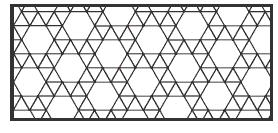
Questions 1, 2, and 4 ask the students to find other patterns using various combinations of shapes. They will soon discover that there is only one possible pattern in each case. They may come up with what appears to be an alternative, but rotating the pattern will show that it is the same as one they already have. There
are only 8 semi-regular tessellations. Questions 1, 2, and 4 cover 6 of these; the other 2 use a dodecagon (12-sided polygon).
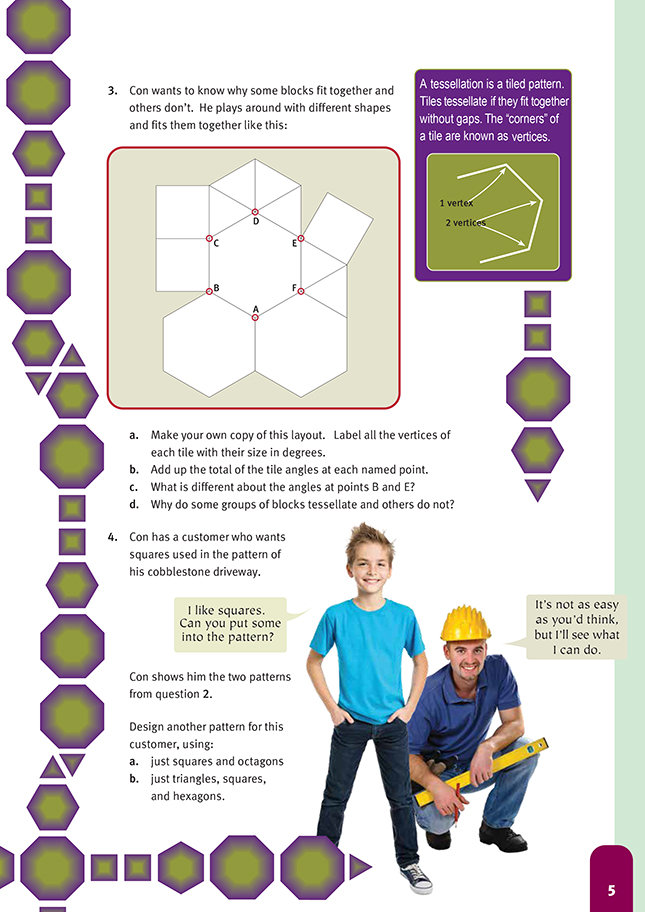
Instead of using a protractor for question 3a, the students should use their prior knowledge of geometrical facts, including:
- the sum of the angles in a triangle = 180 degrees
- each angle in a square = 90 degrees
- each angle in an equilateral triangle = 60 degrees
- the sum of the angles on a line = 180 degrees
- the sum of the angles at a point = 360 degrees
- each angle in a regular hexagon = 120 degrees.
As they work through the rest of question 3, the students should see that the combined angles at any point add to 360 degrees. For example, the 4 angles that meet at C total 60 + 90 + 90 + 120 = 360 degrees. By contrast, the 3 tile angles at B total 120 + 120 + 90 = 330 degrees.
As an extension, you could show your students how to find the size of the angles in a regular polygon using the method shown in the notes for the previous activity. You could also ask them to investigate the tessellations they can make using dodecagons in combination with triangles, squares, and hexagons.
Answers to Activity
1. The only other pattern is:
2. The only other pattern is:
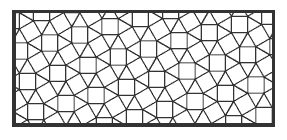
3. a. The angles are all 60o, 90o , or 120o.
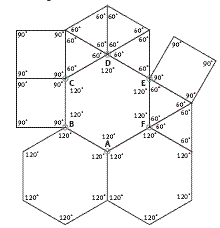
b. A = 360o, B = 330o, C = 360o, D = 360o, E = 330o and F = 360o
d. They will only tessellate if the angles of the vertices that meet at each point combine to give a sum of 360o .
4. a. The only possible pattern is:
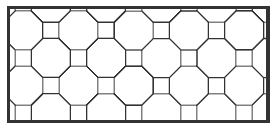
b. The only possible pattern is: