
This is a level 4 number link activity from the Figure It Out series. It relates to Stage 7 of the Number Framework.
A PDF of the student activity is included.
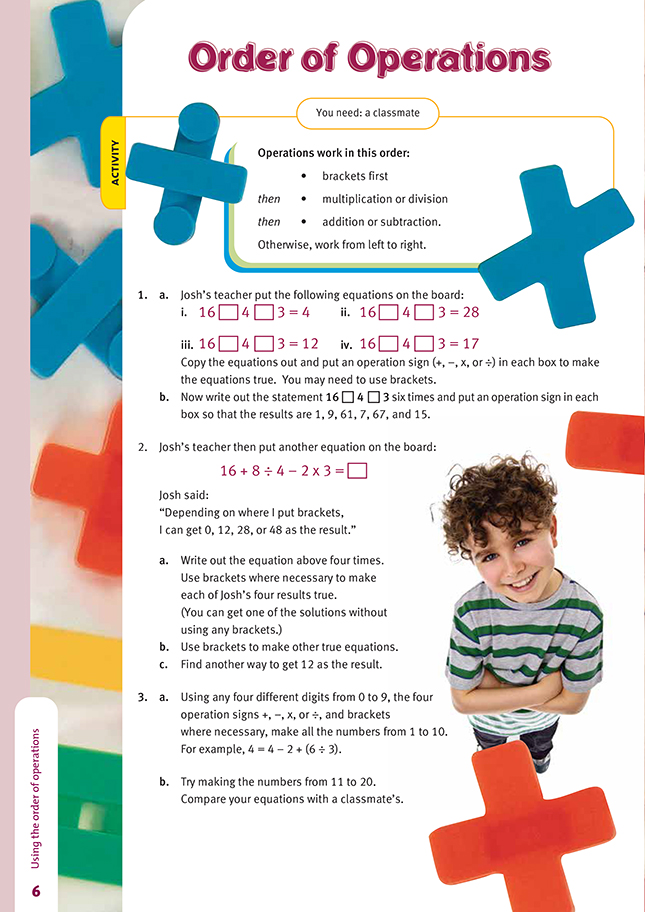
Click on the image to enlarge it. Click again to close. Download PDF (204 KB)
use order of operations to solve problems
FIO, Link, Number, Book Five, Order of Operations, page 6
A classmate
This activity reinforces the students’ knowledge of the conventions for the order of operations, but it is equally important in helping them to expand their understanding of the following algebraic ideas:
• A number can have many names.
• The two sides of an equation name the same number (that is, the equation is an expression, as distinct from a record of a solution involving one or more operations).
If the students are not familiar with using brackets, you may like to work through several examples with them to show the effect of the brackets. For example, in (5 + 2) x 3, you must do the brackets first, so the solution is 21. In 5 + 2 x 3, you do the multiplication first, so the solution is 11.
Question 1 provides numerous examples of how the two sides of an equation name the same number. At the same time, question 1a i is a nice instance of an equation in which more than one solution is possible.
Question 3 is a good example of how a number can have many names. For example, the number 2 can be
9 – 6 – 2 + 1 or (8 – 5) x 2 ÷ 3 or (6 – 4) x 5 – 8.
Answers to Activity
1. a. i. 16 – 4 x 3 = 4 or (16 – 4) ÷ 3 = 4
ii. 16 + 4 x 3 = 28
iii. 16 ÷ 4 x 3 = 12
iv. 16 + 4 – 3 = 17
b. 16 ÷ 4 – 3 = 1
16 – 4 – 3 = 9
16 x 4 – 3 = 61
16 ÷ 4 + 3 = 7
16 x 4 + 3 = 67
16 – 4 + 3 = 15
2. a. Solutions will vary. Possible solutions include:
(16 + 8) ÷ 4 – 2 x 3 = 0
16 + 8 ÷ 4 – 2 x 3 = 12
16 + 8 ÷ (4 – 2) x 3 = 28
(16 + 8 ÷ 4 – 2) x 3 = 48
b. Solutions will vary, but they could include:
(16 + 8 ÷ [4 – 2]) x 3 = 60
(Do the inside brackets before the outside brackets.)
(16 + 8) ÷ (4 – 2) x 3 = 36
(16 + 8) ÷ (4 – 2 x 3) = -12
c. Two ways are:
(16 + 8) ÷ 4 + 2 x 3 = 12 or
([16 + 8] ÷ 4 – 2) x 3 = 12
(Do the inside brackets before the outside brackets.)
3. a. Possible ways include:
0 = 8 – 4 – 3 – 1
1 = 8 + 3 – 5 x 2
2 = 9 – 6 – 2 + 1
3 = (7 – 4 – 2) x 3
4 = 4 – 2 + 6 ÷ 3
5 = (6 – 4 – 1) x 5
6 = (6 – 3) x (4 – 2)
7 = (9 – 4 + 2) x 1
8 = (5 + 7) ÷ 3 + 4
9 = (6 + 4) ÷ 5 + 7
10 = (7 + 4 – 6) x 2
b. Possible ways include:
11 = 6 x 4 – 8 – 5
12 = (3 x 2) + (8 – 2)
13 = 2 – 1 + (3 x 4)
14 = 9 – 3 + (4 x 2)
15 = 1 + (3 x 2) + 8
16 = 3 x 1 + 8 + 5
17 = (9 x 2) – 8 + 7
18 = 5 + 9 + (8 ÷ 2)
19 = 5 x (6 – 2) – 1
20 = (5 x 8) ÷ (2 x 1)