
This problem solving activity has a geometry focus.
Eva, Tamati, Noah and Jo are looking at the objects.
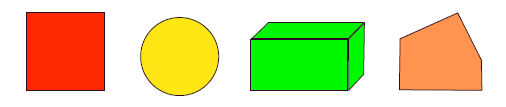
Eva says, Hey, the square is the odd one out.
Tamati says, No, Eva, the circle is the odd one out!
Noah says, No, it is the box!
Jo says, Well you are ALL wrong! The pentagon is clearly the odd one out.
Who is right and why?
- List a number of properties that distinguish squares from circles from cubes from pentagons.
- Devise and use problem solving strategies to explore situations mathematically (make a drawing, use equipment).
This problem explores some basic properties of shapes. It is important for students to have multiple experiences with physically holding and manipulating shapes, naming common shapes correctly, and identifying basic shape properties.
There is no correct answer to this problem. It is likely that the students will come up with several answers that are not listed in the solution. Accept answers that students can justify as correct. Ensure students can explain their thinking, and support them to do so with the use of shape manipulatives.
- Copymaster of the problem (Māori)
- Copymaster of the problem (English)
- Pictures and shape models (or a digital alternative): a square, circle, (irregular) pentagon, cuboid/rectangular prism, and a few other 3D shapes (e.g. cylinder, cube, pentagonal prism)
The Problem
Eva, Tamati, Noah and Jo are looking at the objects.
Eva says, Hey, the square is the odd one out.
Tamati says, No, Eva, the circle is the odd one out!
Noah says, No, it is the box!
Jo says, Well you are ALL wrong! The pentagon is clearly the odd one out.
Who is right and why?
Teaching Sequence
- Show the students the four objects of the problem. Point to the square.
Who knows what this is? What can you tell me about it?
Support students to name the shape, identify the number of sides and corners, and identify that the shape is flat or 3D. - Repeat step 1 for the other three objects.
- Read what each of the four friends say about the objects, and read the problem question.
- Ask students to share how they could solve the problem (e.g. make a drawing, use equipment)
- Have the students work on the problem in groups or on their own. Have them record their ideas in a method of their choosing.
- As the students think about the problem, go round the class and write down some of their answers. Ask them if they can think of more than one way to separate the objects.
- Have some student report back. Collate their ideas in a large table for display and future reference.
- Discuss the Extension problem.
Extension
Ask the students to find other objects in the classroom. Get them to say what makes them different from/ similar to each other and the four objects of the original problem. There can be many solutions to this extension.
Solution
There can be many solutions to this problem because each of the students is correct. Eva is right because the square is red and the other objects are blue. Tamati is right because the circle is the only on that will roll. Noah is right because the box is the only 3-dimensional object. Jo is right because the other objects have symmetry (that is they can be rotated through quarter and half turns on to themselves) but the pentagon doesn't.
You might ask the class to find as many reasons as they can to explain why each object is really the odd man out. This information could be displayed in a table like the one below.
square | circle | cube | pentagon |
it's red | it will roll | it's 3-dimensional | it has no symmetry |
it has four sides | it has only one side | it has 8 corners | it has five sides |
it has four angles | it has no angles | it has 6 faces | it has five angles |
it could be used to tile a floor | ? | it has 12 edges | it has exactly 2 right angles |
? | it could be used as a dice | ? |
You could ask students to help you add the the different properties of the objects and the types of objects to the table. If you have completed the extension, ask the students to figure out where the objects they found in the classroom could be added in the table.