
In this unit we will explore the idea of having benchmarks of 1 kilogram and 1/2 kilogram, or 500 grams, to aid in estimating the mass of given objects.
- Use objects of 1kg mass to estimate the mass of other objects.
- Discuss the need for having and using standard measures of mass.
- Make sensible estimates about the mass of given objects.
- Explain the meaning of metric prefix terminology (e.g kilo).
It is difficult to estimate the mass of individual items. Try picking up a school bag and estimating its mass. It is something most people aren’t that good at because we haven’t had much practice or we don’t have the same ‘onboard’, meaning a benchmark which can be used to compare and describe the measurement attributes of different objects e.g fingertip to shoulder – 1 metre. Students need to develop personal benchmarks with which to measure various objects in their daily lives. Their personal benchmarks need to gradually relate more to standard measures such as 1 kilogram or 500 grams.
Students also need to be provided with opportunities and experiences to explore the connections between kilograms and grams. To support the understanding of these connections students will explore the language of measurement including prefixes such as kilo. The ultimate aim is for students to be able to choose appropriately from a range of strategies including estimation, knowledge of benchmarks, and knowledge of standard measures in order to approach various measuring tasks with confidence and accuracy.
It is of note that mass and weight are not the same thing. The mass of an object is a measure of the amount of matter in it, and is measured in kilograms (kg), grams (g), and milligrams (mg). Weight is the force that gravity exerts on an object and so can vary from place to place. For example, objects weigh less on the moon than they do on Earth, because the moon has less gravity than Earth. In a science context, weight is measured in Newtons (N). However, the terms mass and weight are used loosely, and inaccurately, in everyday speech to mean the same thing.
This unit can be differentiated by varying the scaffolding of the tasks to make the learning opportunities accessible to a range of students. Ways to support students include:
- providing a range of items with a weight of 1kg for students to use throughout the activities. Items such as a 1kg bag of icing sugar or 1 litre of juice would be ideal.
- pairing students up or letting them work in flexible groups of different levels, and encouraging them to share their learning.
The context in this unit can be adapted to recognise diversity and student interests to encourage engagement. Support students to measure the mass of familiar items, items of interest or items from their culture, and encourage students to develop benchmarks for mass using items of importance to them. For example, how many marbles or LEGO bricks are in 1kg? How heavy is your favourite book? Can you find a book that weighs 1kg? How many rugby balls in 1 kg? (two, the weight of a regulation rugby ball is 460g). You could go on a nature walk around the community to locate items from nature to compare the weights of, for example rocks and shells. When providing items for students to weigh, consider how these could reflect the learning interests or cultural diversity of your class.
Te reo Māori vocabulary terms such as maihea (mass), karamu (gram), manokaramu (kilogram), and ine-taumaha (scale for measuring weight) could be introduced in this unit and used throughout other mathematical learning.
- Scales
- Various 1kg weights
- Reusable bags
Session 1
Begin by asking students to bring in their school bag. Pose the question Who has the heaviest bag to carry to school and who carries the lightest bag to school? Several kete filled with rocks or books could be used for the same purpose.
- Begin by selecting 5 or 6 bags (or kete) from around the class – it is important to select bags of various sizes and shapes to discuss that biggest doesn’t necessarily mean heaviest to further explore the idea of conservation.
- Discuss what it means to “weigh” something. Look for students to mention how “heavy” an object is. Students might make connections with weighing ingredients when cooking, or weighing luggage when travelling. As a class, compile a list of contexts in which weighing is an important act of measurement. Display this for the students to reflect on.
- Ask students how they think early Māori people measured different things? Although there is little research to say how early Māori measured weight or mass, it is thought that they measured length by using their body parts (e.g. one arm could measure the length of a fish). Ways of measuring, that used the body as a measuring tool, were used for building houses, whakairo (carving), raranga (weaving), and tā (tattooing). To make sure their measurements were consistent, one person (often a high ranking chief) was chosen within a tribe (iwi) and was given the task of being the “standard measure”. This person was considered to be a taonga, and was remembered throughout generations. Encourage students to share their thoughts - what objects do you think early Māori might have used to measure weight (e.g. stones, tools they made).
- How are we going to go about ordering these bags from the lightest to the heaviest bag to answer our question?
- Gather suggested solution strategies then trial strategies to establish an effective way to order the bags by weight.
- Group students in groups of 5-6 with their bags (or kete). Ask each group to order their bags from least to most heavy.
- Share the techniques and strategies used by each group to order the bags.
- Ask 2 groups to pair up to combine their bags on one continuum of least to most heavy.
Session 2
The following activities are to provide students with experiences to compare weights of different objects and to create a benchmark of what a kilogram feels like.
- Make available a 1kg weight for students to use to give them the ‘feel’ of a kilogram.
- Seat the class in a circle around a variety of items from around the room, from your kitchen, environment etc. Ensure items like 1kg bag of sugar or a 1 litre container of milk or water are included in the items as such items will become useful benchmarks.
- On large sheets of paper draw and label the following buckets.
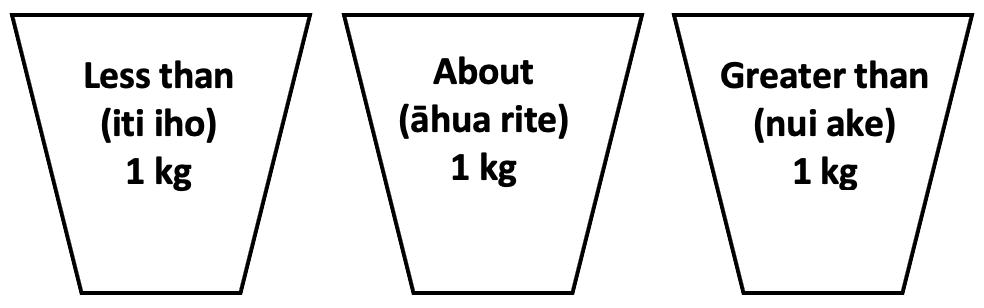
- Ask individuals to select an item and place it in the most appropriate bucket. Before each item is placed in the bucket it would be a good idea to pass the object around the circle for students to feel the mass of each object. This activity could be carried out in smaller groups if necessary to give individuals more hands-on experience.
In preparation for Session 3 ask students to locate items from around their home that they believe would make good benchmarks for 1kg. Ask them to bring along an object that they think has a mass of one kilogram.
Session 3
- Ask individuals to bring their 1 kg benchmark items to the mat.
- Using scales check the actual measurement of each of the items to see how close they are to 1kg. Record the weight of each item in a large table or on separate pieces of paper.
- Give students 5-10 minutes to rove around the circle and hold one another’s item.
- Ask students to discuss which of the benchmarks are the most useful. For example, objects which you don’t usually pick up are not particularly good benchmarks as you will not be familiar with their mass.
- Either individually or in small groups give students a reusable bag and ask them to put one kilogram of something in it. You may prefer to do this activity outside in the sand area (using sand to make a kilogram), in the local environment (use rocks to make a kilogram) or you may do it inside and suggest a range of items that could be used to make one kilogram.
- Weigh the bags and discuss why they are not all exactly one kilogram. Answers could include that different items have been collected of different shapes and sizes, or that people have not collect enough, or have collected too many items. Compare them to the benchmarks.
- Class discussion needs to now focus on how many grams are there in one kilogram? The following types of questions can be asked to explore the connections between grams and kilograms. Students can record their ideas on video to be shared with others.
What does kilo stand for?
How many kilograms is 2000g?
How many grams in 1.5 kg?
Session 4
- Organise students into groups of 2-4 and ask each group to select one of the near 1kg items that were identified from the previous day. This will be used as the group’s benchmark to measure various other items around the room.
- Group members take turns to be blindfolded. In one hand they hold the bench mark and in the other hand they are given another item. The task is to estimate the mass of the mystery item by comparing its mass with the benchmark item.
The blindfolded individual verbally announces their estimate and a non-blindfolded recorder records the estimation. The non-blindfolded individuals can also estimate the mass of the mystery object. - After each estimate students then use scales to measure the item’s mass. The comparison can then be made between the actual mass and the estimated mass.
The process can be repeated for each group member. - This could be turned into a game in which the individuals who estimate within 100 grams earn themselves a point. The first group member to earn four points is the winner. As an extension, you could ask students to figure out how many grams are in each of the objects, or all of the objects together.
Session 5
- Bring this unit to a conclusion by asking students to share the benchmarks they are going to use for 1kg.
- List the various benchmarks on a large sheet of paper or digital device to be displayed and shared as a reference.
- Share the various strategies and techniques students have developed to establish near estimates for objects they are asked to weigh.
- Create a class display or powerpoint of benchmarks, strategies, and techniques.
Dear family and whānau,
This week we are exploring mass and having fun measuring things on the scales and starting to develop a "feel" for a kilogram. Children are asked to bring items to school that they think would be a useful benchmark for 1kg.
Ask your child how much they estimate some items around the house and environment to weigh. Ask them to share their own built in benchmarks for estimating the mass of different items around the home and environment. For example, ask them how much would a big book or a tree branch weigh or ask them to lift a bag of potatoes and explain that it's what 10kg feels like.
We have also learnt a little about how early Māori people measured length using a special person whose job was to be a “standard measure”. Do you know of any different measurement methods or tools that people from different cultures used before the introduction of units like grams, kilograms, centimetres etc.? If you do, we would love to find out more about these different measurement methods.