
These are level 3 number, algebra, and geometry problems from the Figure It Out series.
A PDF of the student activity is included.
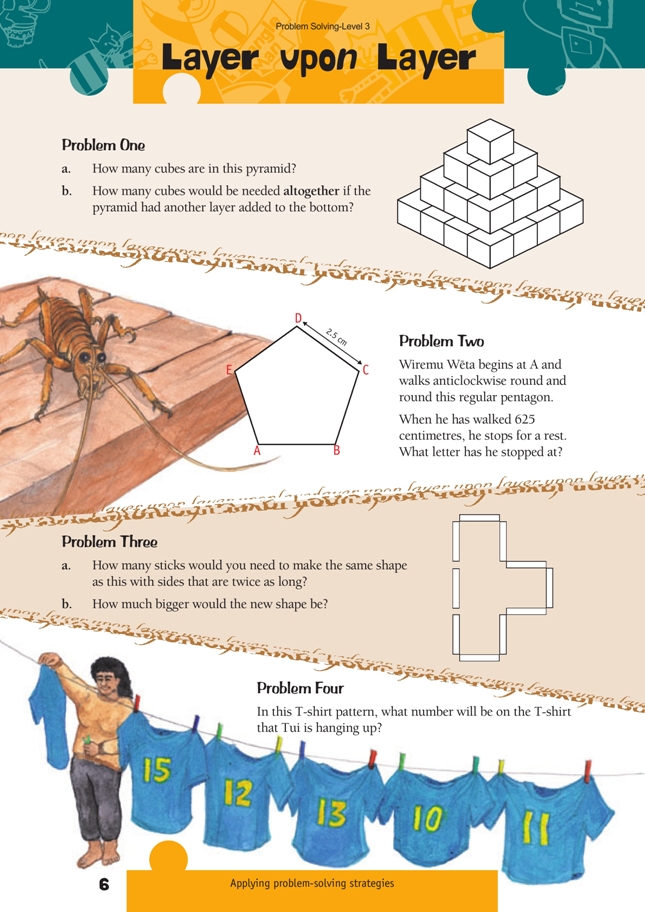
Click on the image to enlarge it. Click again to close. Download PDF (184 KB)
solve problems involving sequential patterns (Problems 1 and 4)
use simple multiplicative strategies to solve problems (Problem 2)
solve problems involving enlargements (Problem 3)
Problem One
Many students will need to build the model with cubes. This is good visualisation in itself because it involves interpreting a diagram of a solid object. Some students may realise that they can calculate the number of cubes in each layer of the building.
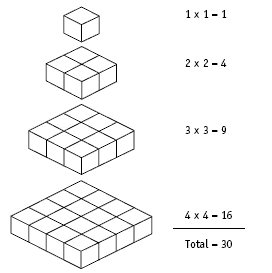
The next layer will be a 5 x 5 square, so it will be made of 25 cubes, giving a total of 55 cubes. Students may be interested in the pattern created by the square numbers, which are central to this problem:
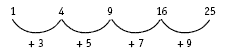
Each difference is the number of extra blocks needed to make each successive square:
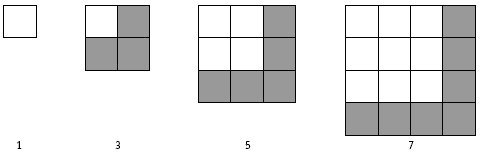
The first block, which becomes a corner square, ensures that each difference is an odd number.
Problem Two
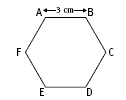
Each side of the pentagon is 2.5 centimetres long, so the total perimeter is 5 x 2.5 = 12.5 centimetres. Twice around the pentagon will be 25 centimetres.
Multiplication and division can be used to solve the problem efficiently instead of repeatedly adding 25. Two possible solution strategies are:
1. 4 x 25 = 100 cm (eight times around)
(6 x 4) x 25 = 600 cm (48 times around)
600 + 25 = 625 (50 times around)
Since 50 round trips end exactly on 625 centimetres, Wiremu Wèta’s journey begins and ends at A.
2. 625 ÷ 25 = 25 double trips, which is 50 trips in total.
There is no remainder, so Wiremu Wèta begins and ends on A.
Students may enjoy variations on this type of problem. For example:
Problem Three
Nursery sticks can be used to model the figure and its enlargement.
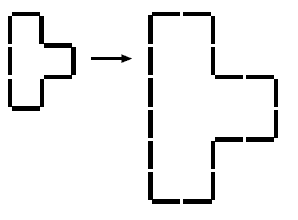
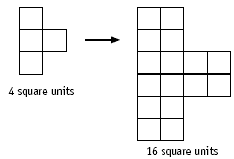
Ten sticks were needed to make the original figure, so twice as many sticks (20) are needed to make the enlarged figure. The diagram below shows that the area of the shape increases four times.
Students may wish to investigate whether this also occurs with any closed figure when the side lengths are doubled. For example:
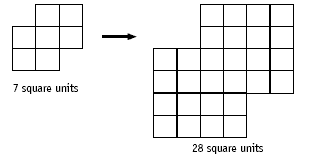
A generalisation is that when the side lengths of a figure are doubled, its area increases by a factor of four.
Problem Four
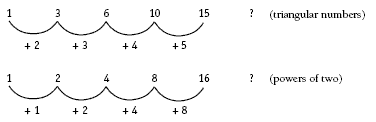
Some students may look for a pattern from left to right if they do not read the question carefully. The different pattern this shows is a useful discussion point.
Following the pattern from right to left shows:

Following the pattern from left to right shows:

Students may need more experience using the difference technique to analyse number sequences.
For example:
Answers to Problems
1. a. 30
b. 55
2. A
3. a. 20
b. The perimeter will be twice as long. The area will be 4 times as big.
4. 14