Te Kete Ipurangi Navigation:

Te Kete Ipurangi
Communities
Schools

Te Kete Ipurangi user options:


Level One > Number and Algebra

Jumping Beans

Purpose: 

This activity explores how numbers relate to ten.  It also encourages the visualisation or imaging of numbers to ten.

Achievement Objectives:

Specific Learning Outcomes: 

visualise numbers up to ten using ten frames

Required Resource Materials: 
beans or multi-link cubes
tens frames
Activity: 
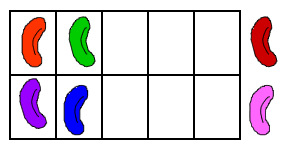
  1. diagram.How many beans are in the ten frame? (4)
    How many beans are outside? (2)

    Now imagine the beans jumping in.
    How many beans are there altogether? 
    How did you solve this?

  2. At this point let the students move the counters to display 6 on the ten frame.

  3. Repeat this with other number combinations.  As an aim of the activity is to encourage students to visualize or image numbers don’t move the beans inside the frame except to verify responses.  Encourage the students to know the numbers by seeing them.


Similar Resources

Facts to 10

Count a set of objects in the range 1–10.

Instantly recognise patterns to 10, including finger and tens frame patterns.

Instantly recognise patterns to 10 including doubles.

Recall the facts up to 10, and the teen facts.


Using Tens Frames for the Strategy of Bridging to Ten

The purpose of this unit is to introduce the part-whole strategy of bridging to ten.

Using Tens Frames for "Teen" Numbers

The purpose of this unit is to recognise and understand teen numbers.  This is an essential piece of knowledge for the part-whole strategy of bridging to ten.

Using Tens Frames to Describe Patterns to Ten

The purpose of this unit is to develop instant recognition of the quinary pattern of the numbers 5-10.  This knowledge is important for building facts to ten.

Using Tens Frames for One to One Counting

The purpose of this “unit” is to recognise the numbers 0 to 10 as represented using the quinary pattern on the tens frame.  This develops the students’ ability to visualise the quinary patterns and is fundamental to future work with tens frames and visualising number patterns.