This is a level 3 geometry activity from the Figure it Out series.
A PDF of the student activity is included.
Click on the image to enlarge it. Click again to close. Download PDF (302 KB)
investigate internal angles of polygons
ruler
scissors
cardboard or paper
protractor
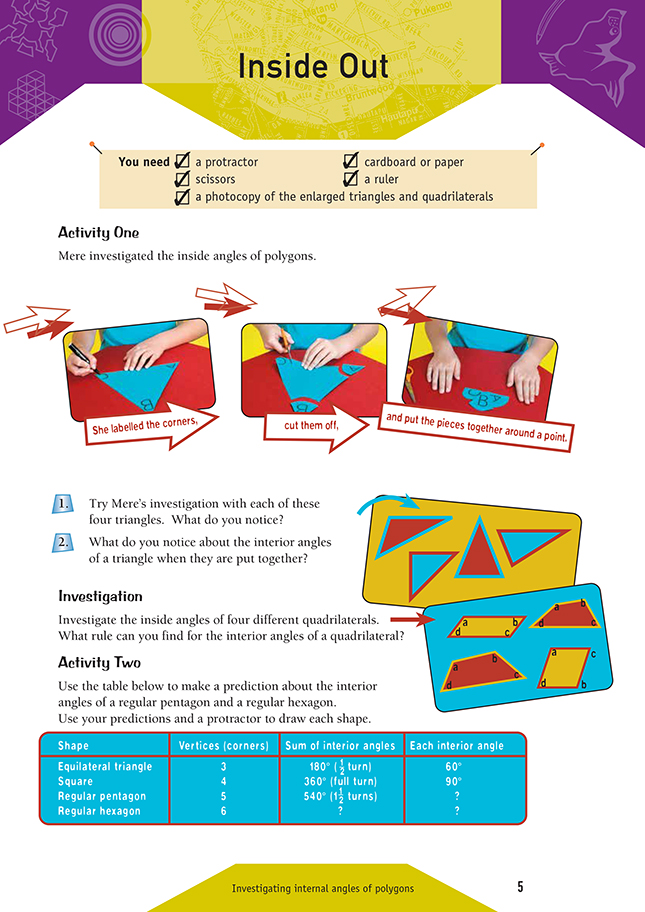
FIO, Level 3-4, Geometry, Inside Out, page 5
photocopy of enlarge triangles and quadrilaterals from student book
Activity One
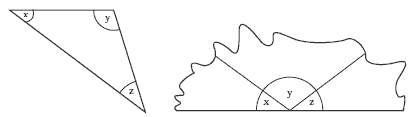
For this activity, you may need to remind the students that the sum of the angles in a straight line is 180° and the sum of the angles in a circle is 360°. This practical task is a very useful way for the students to discover that the sum of the interior angles of a triangle always equals 180°. The students could tear off the corners so that they can clearly recognise the angle originally taken from the triangle.
Investigation
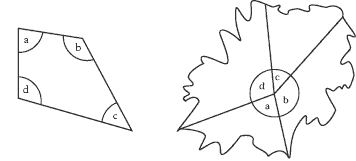
Through this investigation, students should discover a similar proof for the sum of the angles of a quadrilateral. They should draw a range of different quadrilaterals (square, rhombus, trapezium, and so on), label and tear off each of the corners, and place them together to show that they form a revolution (360°).
Activity Two
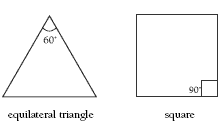
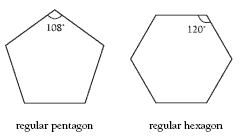
In this activity, students use the sum of the interior angles of a triangle and of a square to find the size of each interior angle of a pentagon and a hexagon. The pattern is that each additional vertex adds another 180° to the sum of the interior angles. Students then use this information to draw the shapes using protractors. After the students have drawn the pentagon and hexagon, they could check the sum of the interior angles by using the same method they used for the triangle and quadrilateral.
Notice that the angles of the pentagon add up to 540° (360° + 180°). This is a full circle plus a semicircle. However, there is no way of combining the individual pieces to form a full circle plus a semicircle. The hexagon yields 720°, which is two full circles.
This activity will help the students when they create tessellations (see page 6 of the student booklet) and explore why certain regular shapes tessellate and others do not.
Answers to Activity
Activity One
1. The pieces of a triangle fit together to form a semicircle. The sum of the angles is 180°.
2. They always add up to 180°.
Investigation
The interior angles add up to 360°.
Activity Two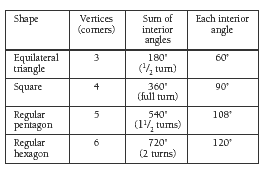
The shapes are: