
Identify highest common factors and least common multiples.
Solve multiplication and division problems that involve fractions.
Number Framework Stage 8
Dividing fractions is probably the most difficult idea students will have encountered in all their experiences with number. It requires careful teaching by the teacher and clever thinking by the students.
Using Number Properties
Problem: “Juanita has 7/8 of a cake. She cuts pieces of 2/9 in size to put in packets for her guests. How many packets of cake will she make?” Write 7/8 ÷ 2/9 on the board.
Discuss why it is hard to compare 7/8 and 2/9. (Answer: They have different names or denominators, eighths and ninths.)
“How could you convert them into like fractions?” (Answer: The lowest common multiple of 8 and 9 is 72, so you could convert eighths and ninths into “seventy-twoths”. So 7/8 = 63/72 and 2/9 = 16/72.)
How would you work out 63/72 ÷ 16/72? (Answer: 63/72 ÷ 16/72 = 63 ÷ 16 = or 3 15/16.)
Examples: Find 2/3 ÷ 4/7
2/7 ÷ 11/3
10/11 ÷ 9/4
5/6 ÷ 7/10
Problem: “Summarise the answers above in a table that discusses a quick way of dividing fractions.”
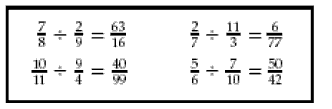
(Answer: Flipping the second fraction and multiplying always works. So, for example 7/8 ÷ 2/9 = 7/8 x 9/2 = 63/16.)
Examples: Find: 2/3 ÷ 4/7
2/7 ÷ 11/3
10/11 ÷ 9/4
5/6 ÷ 7/10...
Understanding Number Properties:
What letters replace the question marks? a/b ÷c/d = (? x ?)/(? x ?)
(Answer: (a x d)(b x c).)