
This unit introduces Pythagoras’ Theorem by getting student to see the pattern between the length of the hypotenuse of a right angled triangle, and the lengths of the other two sides. Applications of the Theorem are considered, and students see that the Theorem only covers triangles that are right angled.
- Find lengths of objects using Pythagoras’ Theorem.
- Understand how similar triangles can be used to prove Pythagoras’ Theorem.
- Understand that Pythagoras’ Theorem can be thought of in terms of areas on the sides of the triangle.
Against the background of Pythagoras’ Theorem, this unit explores two themes that run at two different levels. At one level this unit is about Pythagoras’ Theorem, its proof and its applications. At another level, the unit is using the Theorem as a case study in the development of mathematics. So, after some experimentation, we try to guess what the Theorem is and produce a subsequent Conjecture. We then test the Conjecture in a number of situations and prove the Conjecture, before checking the Theorem to see if it applies to triangles, other than right angled ones, in an attempt to extend or generalise our result.
Learning to ‘interrogate’ a piece of mathematics the way that we do here is a valuable skill. By this 'interrogation' we mean that it should be read and checked by looking at examples and e applied to a new situation. The conditions of the Theorem should then be changed slightly to see what effect that has on the truth of the result. This process will help students to look at any piece of new mathematics and have the confidence that they can find out what the mathematics is and how to apply it. It also provides a deeper understanding of what the result says and how it may connect with other material.
The title of the unit, the Gougu Rule, is the name that is used by the Chinese for what we know as Pythagoras’ Theorem.
Before doing this unit it is going to be useful for your students to have worked on the Construction unit, Level 5 and have explored similar triangles.
The learning opportunities in this unit can be differentiated by providing or removing support to students and by varying the task requirements. Ways to differentiate include:
- grouping students flexibly to encourage peer learning, scaffolding, extension, and the sharing and questioning of ideas
- apply the gradual release of responsibility to scaffold students towards working independently
- allowing the use of calculators to estimate and confirm calculations
- encouraging students to describe expressions and linear patterns in words, and scaffolding them towards the use of symbols
- providing frequent opportunities for students to share their thinking and strategies, ask questions, collaborate, and clarify in a range of whole-class, small-group, peer-peer, and teacher-student settings.
This unit is focussed on investigating Pythagoras’ Theorem, and as such is not set in a real world context. You can increase the relevance of the learning in this unit by providing ample opportunities for students to create their own problems, create their own representations of a task, and participate in productive learning conversations.
Te reo Māori kupu such as tauira (pattern), ture (formula, rule), and koki hāngai (right angle) could be introduced in this unit and used throughout other mathematical learning.
- String
- Scissors
- Protractors
- Compasses
- Red ink
- Pencils
- Rulers
- Drawing pins
Session 1

- Pose this question to the whole class.
Why did Pythagoras kill 100 oxen?This might lead into a discussion of who Pythagoras was, when did he live, where did he live, what are oxen, and so on. Gradually reveal enough information to lead into the fact that he had just proved a theorem.
- We want to find out what Pythagoras’ Theorem is, how it can be justified, and what uses it has.
What is a theorem?
Does anyone know what Pythagoras’ Theorem says? What objects does it deal with? - Encourage students to share their knowledge and tell them that the Theorem has "something to do with the lengths of the sides of a right angled triangle".
- Revise the basic ideas, especially the word hypotenuse and the concept of a right-angle triangle.
- We are now going to collect some data so that we can conjecture the relationship between the side lengths of a right angled triangle. Show students a diagram like the one below. You may want to look at specific values of a, b, and h before you go to the general case.
How could you collect this data?
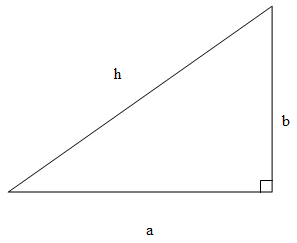
- Lead students to the idea of drawing several triangles and measuring their sides. Help them to see that, by pooling their individual data, the class as a whole can collect a great deal of data even if each student only collects data from a few triangles.
How could we do it systemically so that it will be easier to guess what will happen in the general case?
Help them to see that they may get more insight into the problem by making small variations from triangle to triangle. So they might decide that this group of students should all start with a base length, a, of 3 but one student will use b = 4 and 5, another student will use b = 6 and 7, and so on.
- Now give students the chance to draw a couple of right angled triangles. This should be done as accurately as they are able to, so it is worthwhile for them to used rulers and compasses to construct their right angles. Ensure your students understand how to construct a right angled triangle. You might model the processes involved initially and scaffold students to constructing them independently. Emphasise that students need to measure the sides as accurately as possible.
- Construct a table on the board with all of the students’ results on it stating from smallest a and b upwards. Give them a chance to copy this table in their books. It might looks something like the one below.
a | b | h |
3.0 | 3.0 | 4.2 |
3.0 | 4.0 | 5.0 |
3.0 | 5.0 | 5.78 |
4.0 | 4.0 | 5.64 |
- Discuss the numbers in the table:
This table seems very complicated. It may be difficult to see any pattern here at first glance.
Can we say what patterns don’t hold? Is there a linear relation between a, b, and h?
It might be easier to see what happens if we compare situations where a and b are the same or similar.What do you have to multiply 3 by to get 4.2?What do you have to multiply 4 by to get 5.64?Is there a pattern here? Test it against other data on your table.
- Try the same thing with 3 and 4, and 6 and 8, and 9 and 12. How does this connect to the last case where a and b were the same?Lead students to the well known formula:h2 = a2 + b2 or a2 + b2 = h2.
- What is the conjecture that we now have?Conjecture: If we have a right angled triangle with side lengths a, b, c, where c is the hypotenuse, then h2 = a2 + b2. ORConjecture: In a right angled triangle the square of the hypotenuse is equal to the sum of the squares on the other two sides. OR …Encourage students to say, and then write, the conjecture in as many different ways as they can.
- Have students test the Conjecture against various other values from the table. Because of rounding errors, in measurement and calculation, they can’t expect to find that every piece of data fits exactly. However, the data should be a reasonable fit to the equation, meaning it should enable them to be confident that the equation is not too bad anyway. It is possible that some piece of data doesn’t fit at all well. It might be worth checking the drawing and measurements for this case to see if there was an error here.
- Finish the session by giving them time to write down the Conjecture and their comments on the Conjecture.
- Use a string line whose length is a convenient multiple of 12 cm; mark a point on the string the same multiple of 4cm from one end and another point the multiple of 5cm from the other end on the string.
- Pin down both ends of the string at the same point. Then pull the string taut so that the string makes a 3, 4, 5 triangle. You can then see where the right angle is.
Which method is more accurate and why?
Maybe the bigger number leads to a more accurate right angle?
- How can you make a right angle?Students should recall how they made a right angle in the last session (i.e. from making a right angled triangle).What if you wanted a right angle outside in the school yard? What if you were marking out a soccer field?
Let’s see how to tackle this problem.
- Let the students work in pairs. Let them have a piece of string, a ruler, a pair of scissors, red ink, and a protractor. Leave them with the challenge of using only the pencil, the string (the scissors), drawing pen, red ink, and the ruler to make a right angle. (See Teachers’ Notes. Clearly some of this equipment is redundant.) Tell them they can check the accuracy of their right angle with the protractor.
- Go round the class and check progress. Let them struggle with the problem for a while.
- Have a reporting back session. If they can’t do the problem without help, discuss the problems that they are having and how these might be overcome.
- Let the students work in pairs to implement one of the methods that have been discussed. Get them to check their angles with a protractor.
Which of the various methods seem to be the most accurate?
Is there a reason for this?
- Give the students time to record their summary of the session.
 cm.
cm.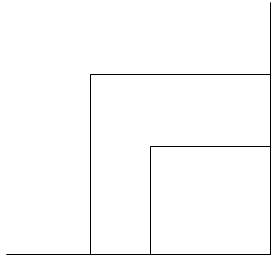
- Problem: A spider wants to make a web in a shoe box with dimensions 30 cm by 20 cm by 20 cm. What is the shortest length of web she can string from one corner of the box to the opposite corner?
Pose the problem. Say that it is probably a little hard to tackle at the moment so let’s work up to it.
- Get the students to work in pairs to construct squares with side lengths 5 cm, 8 cm and 10 cm.Can you find the length of the diagonals of those squares?Is their another way to do this? Use it to check your first answer.
- Have a reporting back session to check that everyone is on top of the problem. Now repeat step 2 using at least three rectangles. Specify whatever side lengths you think best.
- Have a reporting back session. Now repeat step 2 asking them to find the heights (altitudes) of at least three equilateral triangles. Specify whatever side lengths you think best.
- Now go back to the original problem. Show a model of the problem. Discuss ways that this might be tackled. Can you solve this problem by measuring?
Let them solve the problem. You might let them work on constructing a box so that they can measure the diagonal, either in class or at home.
- Have a reporting back session. Get them to write up their experiences.
- If there is time, you might ask them to find the height of the point B above the line in the diagram below. Here the circles have a radius of 5 cm.
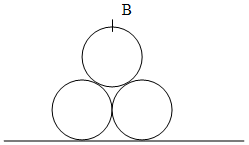
- Remember there have to be two distinct ways of doing this. One is clearly measuring. One is not. Discuss their methods.
 , so using the letters,
  . This gives a2 = cs.
 , so using the letters,
  . This gives b2 = ct.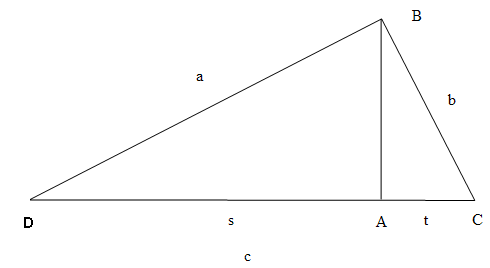
- So far we really only have a Conjecture so we can’t fully believe it. Certainly it seems to give us the right answer every time we use it but in maths we need to be able to prove/justify everything before we can use it with confidence. So in this session we look at the proof of the Conjecture. This will enable us to believe that Pythagoras’ Theorem is true.
- How can we prove something like this?
Actually there are literally hundreds of proofs.
Do you have any suggestions? (They might remember a proof from Pythagoras’ Theorem, Measurement, Level 5.)
- Take them through the proof given in the Teacher Notes. This can be done by giving them specific examples of right angled triangles and getting them to show that the appropriate triangles are similar and that a calculation will show the required squares satisfy the conjecture. Then you might like to take them step by step through the proof that uses similar triangles. Ask them help you to explain why each step holds.
- Let’s now, as they say, interrogate the Theorem.What are the key points of the Theorem statement? (right angled triangle; side lengths; sums of squares.) Each of the key points is needed in the statement.Will any other equation link a, b, and h?Can we get away without the right angle in the triangle?
- Get the students to work their way through these two questions working in pairs. Can they find any other equation?Does a2 + b2 equal h2 in any other triangle?This can be done by looking for other ways to link the lengths of the sides and by drawing other triangles where h is not a hypotenuse to see if the known equation holds.Let the students report back. It is not possible to find any other equation linking a, b, and h. If we don’t have a right angle in the triangle, then we don’t havea2 + b2 = h2.This exercise shows that the Theorem has no fat in it. There are no pieces that can be thrown away.
- Actually if there is no right angle we can still get an equation but it’s called the Cosine Rule.
- Give the students time to write notes about what they have done in their note books.
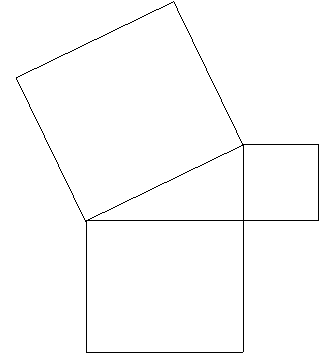
 .
. .
. . By Pythagoras, this equals
  , which is just what we were trying to show.
- Discuss the area nature of Pythagoras’ Theorem.
Does the shape on each side have to be a square? Are there other shapes that could be used?
- Send the class off in pairs to look at semi-circles. The Conjecture that they are pursuing may be “The area of the semi-circle on the hypotenuse of a right angled triangle is equal to the sum of the areas of the semi-circles on the other two sides”. Let them do this by first looking at specific examples. If the examples work they should then by try to prove it in general.
- When the students report back, they should see that the Conjecture is true. The easiest way to prove this is to use Pythagoras’ Theorem (for squares).
- Get them to go back into their pairs to look at whether the statement is true if we replace square by equilateral triangle, regular hexagon, and rectangle. They should know to experiment with particular examples first and then try to prove it in general. This proof will rely on the statement of Pythagoras’ Theorem for squares.
- When the students report back, they should see that the Conjectures are true for regular shapes but not for the rectangle.Why is there a problem with the rectangle?Discuss.
- Let the students write up their findings in their books.
Dear families and whānau,
Recently we have been investigation Pythagoras’ Theorem. Ask your child to share with you what they know about the applications of Pythagoras’ Theorem.