This is a level 4 number link activity from the Figure It Out series. It relates to Stage 7 of the Number Framework.
A PDF of the student activity is included.
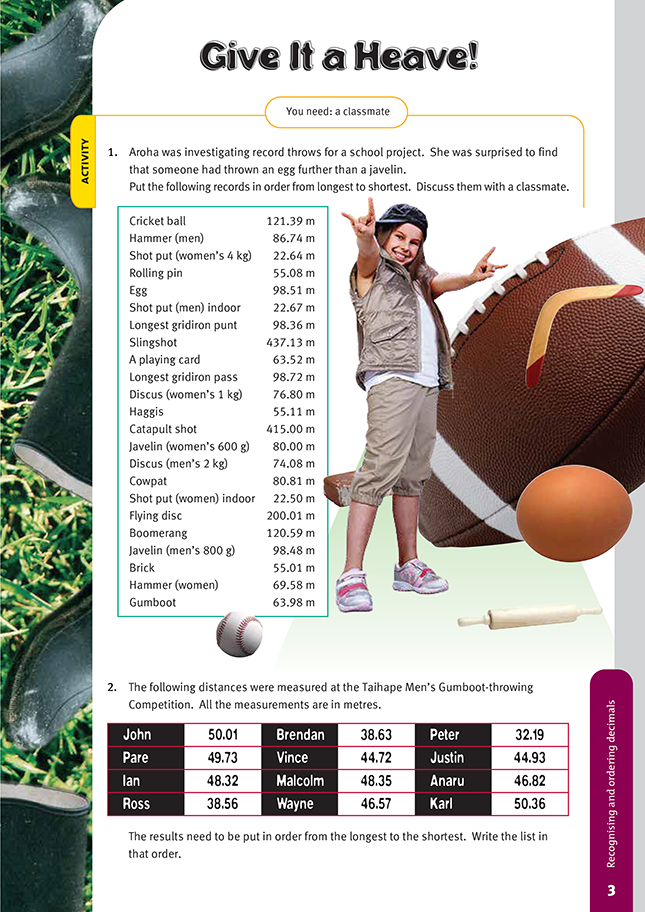
Click on the image to enlarge it. Click again to close. Download PDF (249 KB)
order decimals to two decimal places
FIO, Link, Number, Book Five, Give it a Heave, page 3
A classmate
In this activity, the students order distances to two decimal places. You may find that you need to check your sudents’ understanding of tenths and hundredths. Some students think that the first column to the right of the decimal point is “oneths”, a mirror image of the columns of whole numbers. These students may need practical examples, such as money, to help them realise that this column represents tenths. Using money can be helpful because money amounts are written in decimal form ($1.10). The students who come to see that 10 cents is 1/10 of $1, that 50 cents is 1/2 or 5/10 of $1, and so on, are less likely to think that 0.35 is bigger than 0.5 because they can now think of the 0.35 as 35 cents and the 0.5 as 50 cents. The use of centimetres on a metre ruler can also be useful. For example, you can help the students understand that 8 centimetres is 8 out of 100 (that is, eight-hundredths or 8/100) and is written as 0.08 (no tenths involved), whereas 35 centimetres is 35/100 (or 3/10 and 5/100) and is therefore written as 0.35.
Another key understanding that you could develop in the midst of these two activities is that as you move left across the columns, each is 10 times greater than the one before it, and moving right has the opposite effect: each is 10 times less. Thus 5 is 10 times greater than 0.5, and 0.05 is 10 times less than 0.5. This understanding is extremely helpful for mental calculations of the type $2.50 ÷ 10 (which immediately gives $0.25 or 25 cents).
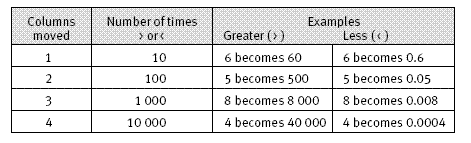
Although it is not required for this activity, you could use this understanding as an opportunity to help the students see that moving across two columns means that a number is 100 times greater or less, moving across three columns means that a number is 1 000 times greater or less, and so on. The students will soon realise that there is a pattern at work here in that the number of places moved relates to the number of zeros and indicates how many times greater or less. They could set this out in a table, for example:
Answers to Activity
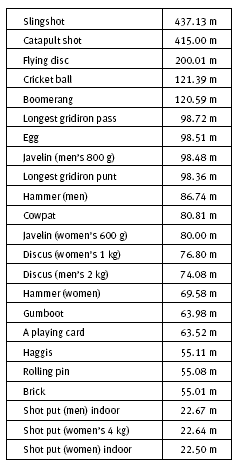
1.
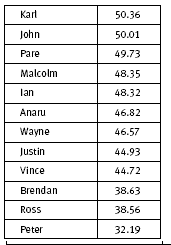
2.