
Solve multiplication and division problems that involve decimals.
Scissors
Highlighters (or crayons or felt pens)
Using Materials
Give the students a paper copy of the whole decimat. Tell them to fold their mat in
half and then fold the half in half again. Get them to shade the last folded area with
a crayon or felt-tip pen.
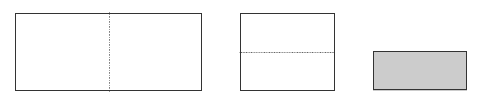
Ask, “What is one-half of one-half?” (one-quarter). Students can use a whole decimat to check how much of the original one was shaded.
Ask, “How do we write that as an equation?” (1/2 x 1/2 = 1/4) and, “What would this equation look like recorded as decimals?” (0.5 x 0.5 = 0.25).
Get the students to discuss patterns they can see in the equations and why
they occur. Look for responses such as: “The denominators of the fractions are
multiplied, like 2 x 2 = 4.” Ask how we could predict the denominator from our
folding. (Halving created two parts that were each divided into two parts.)
Students might comment that the decimals behave like whole numbers, as in
5 x 5 = 25. Ask, “What does the decimal point do?” (defines where the ones place is).
Use paper folding to further develop students’ understanding of what happens
to the numerators and denominators of fractions when they are multiplied and
how the correct position of the decimal point can be determined in decimal
multiplication by understanding the answer size. Focus on how the numerator and
denominator in the answer can be predicted from folding and shading.
Good examples are:
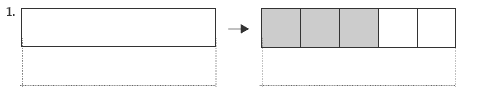
3/5 x 1/2 = 9/20 or 0.6 x 0.5 = 0.3 (three-fifths of one-half)
Each of the two parts (halves) was divided into five parts (fifths), creating
5 x 2 = 10 parts (tenths).
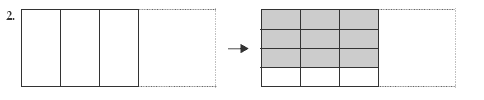
3/4 x 3/5 = 9/20 or 45/100 or 0.75 x 0.6 = 0.45 (three-quarters of three-fifths)
Students should note that the numerators are multiplied because the selected
shaded area has an area of nine (3 x 3). 75 hundredths of 6 tenths gives an answer
of 450 thousandths (0.45).
Using Imaging
Provide the students with other examples that could be solved by folding, cutting,
and shading. Expect the students to image the process on materials and justify their
answers. Suitable problems are:
0.3 x 0.3 = 0.09 (3/10 x 3/10 = 9/100)
1/4 x 2/5 = 2/20 = 1/10 (0.25 x 0.4 = 0.1)
3/4 x 1/2 = 3/8 (0.75 x 0.5 = 0.375)
1.5 x 0.5 = 0.75 (3/2 x 1/2 = 3/4)
0.6 x 0.02 = 0.012 (3/5 x 2/100 = 6/500 = 12/1000)
8/1 x 3/4 = 24/4 (8 x 0.75 = 6)
Using Number Properties
Provide students with problems that are difficult to image, ensuring that one
fraction or decimal is well known. Suitable examples might be:
0.25 x 4.8 = 1.2
2.4 x 0.75 = 1.8
3.5 x 0.6 = 2.1
0.9 x 1.9 = 1.71
6.4 x 0.125 = 0.8
40 x 0.4 = 16.0
0.2 x 15.5 = 3.1
0.9 x 0.3 = 0.27
3/4 x 5/2 = 15/8 or 1 7/8
4/5 x 1/4 = 4/20 = 1/5
4/5 x 9/100 = 36/500 = 72/1000
6/8 x 1/2 = 6/16