
This is a level 2 algebra activity from the Figure It Out theme series.
A PDF of the student activity is included.
Click on the image to enlarge it. Click again to close. Download PDF (406 KB)
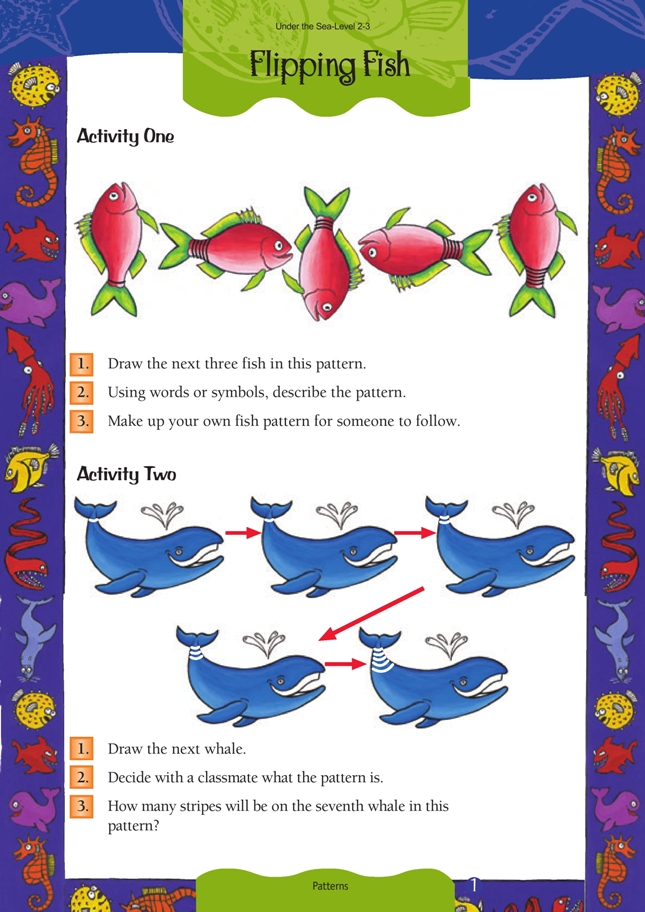
continue a spatial pattern and describe the rule
continue a sequential pattern and describe the rule
Activity One
There are two variables in this fish pattern: the orientation of the fish and the number of stripes on its tail. To make rules for the pattern, it is wise to analyse each variable separately: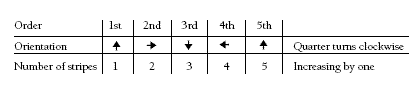
This pattern is a good example of how important it is to help students understand the concept of a relationship. In this case, two relationships exist: one is between the order of the fish and its orientation; the other is between the order of the fish and the number of stripes.
Activity Two
The variable in the whale pattern is the number of stripes on its tail. This pattern is known as the Fibonacci sequence and is named after a famous mathematician called Leonardo Fibonacci of Pisa, Italy, who lived nearly 800 years ago. The Fibonacci sequence progresses as 1, 1, 2, 3, 5, 8 …
Each new number in the sequence is found by adding the previous two numbers (for example, 2 + 3 = 5, 3 + 5 = 8). So the next number in the sequence shown above is 13, the result of 5 + 8.
Examples of the Fibonacci sequence are found in nature, such as in the number of new stems in plants and the family trees of bees. The number sequence is the subject of much investigation and has many fascinating patterns, such as: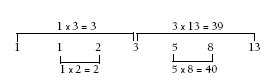
The product of the outside numbers in a set of four Fibonacci sequence numbers is always one greater than or one less than the product of the centre pair of numbers.
Answers to Activities
Activity One
1.
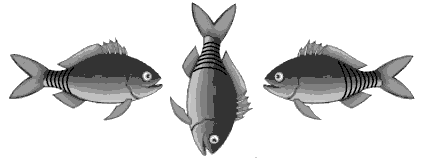
2. Do a quarter turn clockwise and add an extra stripe each time.
3. Answers will vary.
Activity Two
1.
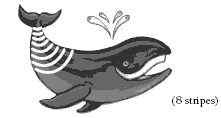
2. After the first two numbers, each new number in the sequence is found by adding the previous two numbers (1 + 1 = 2, 1 + 2 = 3, 2 + 3 = 5, 3 + 5 = 8, 5 + 8 = 13, etc.).
3. 13 stripes