
Purpose
This problem solving activity has a number (addition and subtraction) focus.
Achievement Objectives
NA1-3: Know groupings with five, within ten, and with ten.
Student Activity
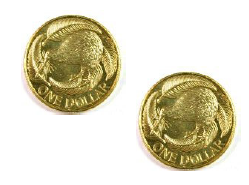
Emma had a $5 note.
She exchanged it with her brother Sam for three coins.
What were the three coins?
Specific Learning Outcomes
- Identify the value of coins and notes to $5.
- Devise and use problem solving strategies to explore situations mathematically.
Description of Mathematics
This problem shows a knowledge of both coins and what three whole numbers add to 5. It can also be solved using play money.
Required Resource Materials
- Coins and $5 note
- Copymaster of the problem (English)
- Copymaster of the problem (Māori)
Activity
The Problem
Emma had a $5 note. She exchanged it with her brother Sam for three coins. What were the three coins?
Teaching Sequence
- Display the different coins and notes to the class.
- Play "guess the coin". Encourage students to ask questions that could be answered with 'yes' or 'no'. Give clues about the attributes of the coin (e.g. size, picture, colour, thickness etc.).
- Pose the problem to the class. Encourage students to draw, use the materials, and act out the exchange of money to solve the problem.
- As the students work, either individually or with a partner, ask them questions that focus their thinking on the coins.
Which coin has the largest value?
What could you buy with this coin?
What could you by with these 2, 3, 4 (etc.) coins? How much would it cost altogether?
Are there more ways we could make $5 with these coins?
Can you tell me what is on the other side of this coin? - Share solutions.
Extension
Emma exchanged the $5 note for 5 coins. What could they be?
Solution
The three coins are two $2 coins and a $1 coin.
Solution to the Extension
Five $1; $2, $1, $1, 50c, 50c.
Attachments
FairExchange.pdf93.5 KB
TeWhakawhitiMoni.pdf159.72 KB
Add to plan
Level One