
In this unit the students use a small plastic dinosaur as the unit with which to measure the capacity of containers. They apply their counting strategies and discover that a number of different shaped containers can contain the same number of dinosaurs.
- Use non standard units to measure the volume of a container.
- Accurately count a set of up to 20 objects.
Measurement provides a context for the further development and reinforcement of number skills. Students can measure without the use of numbers up to the stage of indirect comparison. However as soon as they repeatedly use a unit to measure an object they need numbers to keep track of the repetitions.
This unit is also designed to allow students to practice their one-to-one counting as they calculate the capacity of containers filled with plastic dinosaurs.
The learning opportunities in this unit can be differentiated by providing or removing support to students and by varying the task requirements. Ways to support students include:
- ensuring that the rectangles provided in session 2 hold exactly 10 objects. Alternatively the task could be made more complex by providing some rectangles that were too large and needed to be cut to size by the students
- splitting the digits used in sessions 3-4 into two “hats”, one for digits 1-10 and the other for digits 11-20. Direct students who are less confident with their numbers to 20 to select from the 1-10 “hat”.
The context for this unit can be adapted to suit the interests and experiences of your students. For example:
- choosing objects to be used as measuring units from your local environment (for example, shells or pebbles) or to match the interests of your students (toy cars, small teddy bears, toy unicorns, marbles). It is important though that the objects used are identical or very similar in size.
- counting in te reo Māori could be used in this unit when one-to-one counting is used.
- Small plastic dinosaurs of the same size (or other appropriate objects).
- A number of small containers (that hold up to 20 dinosaurs).
- Lightweight cardboard or heavy paper
- Paper
- Scissors
- Tape
- Recording Sheet
Session 1
In this session we measure the capacity of containers by counting the number of dinosaurs they hold.
- Gather the class on the mat and show them a small empty container and a bag of plastic dinosaurs. Ask:
How many dinosaurs do you think would fit in this container?
How can we check? - Place the dinosaurs in the container one at a time counting as each one is added.
One, two, three, four... - When the container is full ask the students to state how many dinosaurs the container holds. Record this on a label and attach to the container.
- Show the class another container and ask them once more to guess how many dinosaurs it would hold.
- Count in ones as the dinosaurs are added to the container.
How many dinosaurs does this container hold? - Ask for a volunteer to record the number on a label to attach to the container.
- With both containers on display ask:
Which container holds the most dinosaurs?
How do you know? (This will reinforce the order and sequence of numbers.) - Give small groups of students a container and enough dinosaurs to fill them. Write that number on the label and attach it to the container.
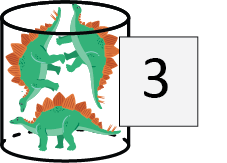
- Gather the students back together as a class to share. Put those with the same number of dinosaurs together.
Do these containers hold the same number or dinosaurs? (check).
Are they the same?
Session 2
In the following sessions the students create cylinders to contain a given number of dinosaurs. The challenge is to create a cylinder that contains exactly the given number of dinosaurs. The activities give students the opportunity to practice counting objects in ones, and to order and compare numbers using objects. This is a good opportunity for your students to practice counting in te reo Māori.
- Gather the students as a class and show them a cylinder made from a rectangle of lightweight card. The base of the cylinder is a piece of paper held in place with tape.
How many dinosaurs do you think it would hold exactly? (Discuss that exactly means that no more dinosaurs could fit into the cylinder.) - Count the dinosaurs one by one into the cylinder.
- Tell the students that they are toy dinosaur manufacturers and that they sell their dinosaurs in packages of ten. Their task is to make a cylinder that holds exactly 10 dinosaurs.
- Provide a selection of different sizes of lightweight card rectangles to make a range of cylinders (short and wide, tall and narrow).
- Ask the students to work with a partner to first take 10 dinosaurs and then make a cylinder. When they have completed one cylinder they can be challenged to make a different cylinder that also holds exactly 10 dinosaurs.
- As the students construct their cylinders circulate asking questions:
Please count your dinosaurs to me.
Does your cylinder fit exactly 10 dinosaurs?
Can you fit any more dinosaurs in your cylinder?
Are cylinders a good container for dinosaurs? Why or why not?
Could you make a cylinder for 20 dinosaurs? What would it be like? - Gather the students back together to share the cylinders constructed.
What do you notice about the cylinder?
Can you see any cylinders which are exactly the same?
What do you think that a cylinder for 20 dinosaurs would look like? - Challenge the students to think about how cylinders can look different but still hold the same amount.
Sessions 3-4
In these sessions the students continue their exploration of the capacity of cylinders by constructing cylinders for a given number of dinosaurs. As the containers are created they are displayed in order of capacity. Many opportunities are provided for one-to-one counting and sequenceing of numbers in English and te reo Māori.
- Gather the students together as a class and ask them to identify the numerals 1-20 as displayed on numeral cards. As the numbers are identified, place them into a “hat".
- Ask the students in partners to select a numeral card from the “hat". Instruct them to create a cylinder to fit that number of dinosaurs.
- When the cylinder has been created, direct the students to write the numeral on the outside of the cylinder.
- Ask the students to place their cylinders, in order, at the front of the classroom.
Where does your cylinder belong?
How do you know it comes after __?
Which cylinder will come after your one? - At the end of the session gather the students together to look at and compare the capacity of the cylinders.
How many dinosaurs does this one hold?
Which one holds one (2, 3..) more? How do you know?
Which one holds one (2, 3..) less? How do you know? - Discuss the different shapes and sizes of the cylinders.
Which cylinders look the biggest?
Do they hold the most dinosaurs?
Session 5
In today’s session each student makes a cylinder. We then use the cylinder to see how many objects (cubes, dinos, etc) can fit exactly into our cylinder.
- Give each pair of students a piece of card and paper to construct a cylinder.
- As they construct the cylinders ask them to guess how many dinosaurs they think would fit in their cylinder.
- Gather the students together on the mat and show them a selection of small objects that they are to use to fill their cylinders. These may include: cubes, pebbles, toothpicks, toy animals, counters, marbles etc.
- Place the objects on tables around the room.
- Ask the students to take turns at each of the tables filling their cylinder with the objects. Suggest that each student has a turn counting the objects by ones into the cylinder while their partner listens and checks their count. Tell them to record the number of objects onto the recording sheet.
- As the students work, check their one-to-one counting and the numbers that they are writing onto the recording sheet.
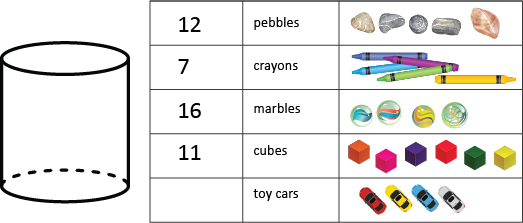
Family and whānau,
In maths this week we have been practising counting objects up to 20 as part measuring how much a container can hold. As part of our experiences we have constructed cylinders to fit certain numbers of toy dinosaurs. Our home task this week is to make a paper or cardboard cylinder that fits 20 small objects (for example; pebbles, toothpicks or milk lids). Your child will need paper or light card (the side of an old cereal box would be good), scissors and tape and they will be keen to show you what to do.