
This is a level 4 number link activity from the Figure It Out series. It relates to Stage 7 of the Number Framework.
A PDF of the student activity is included.
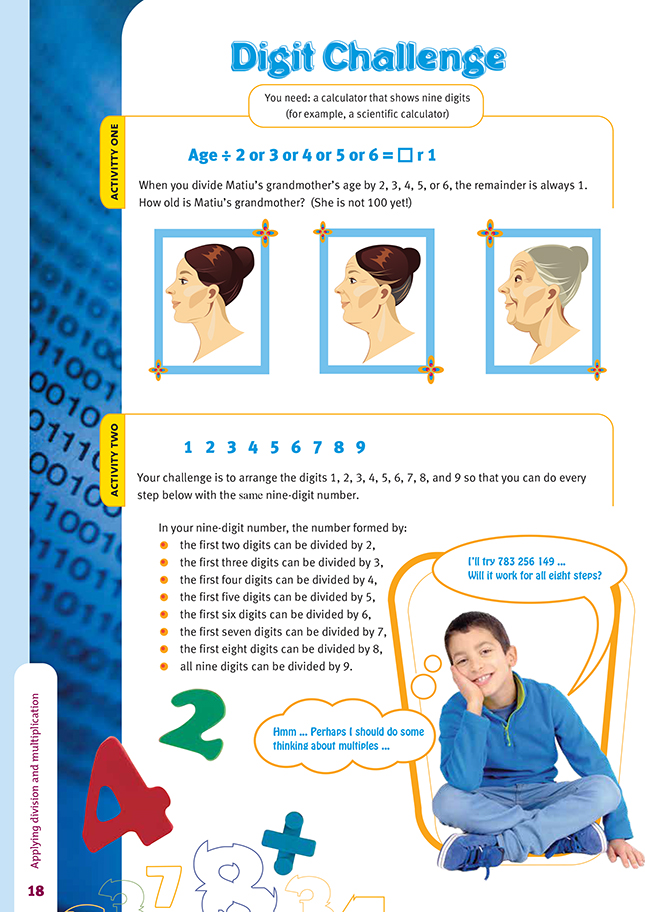
Click on the image to enlarge it. Click again to close. Download PDF (222 KB)
use divisibility rules
A calculator that shows 9 digits (e.g scientific calculator)
FIO, Link, Number, Book Three, Digit Challenge, page 18
Activity One
You could suggest to the students who are struggling to get started that the problem-solving strategy of eliminating is a good way to begin. They need to make their own discoveries, but the most important clue is the remainder of 1. The students may realise that a good place to start is with numbers ending in 1 and 6 because numbers divisible by 5 always end in 0 or 5, and the 1 or the 6 would give the remainder of 1.
(Matiu’s grandmother is likely to be between 40 and 100.) They can then eliminate all the numbers ending in 6 because they are even. Finally, the students could check which of the remaining numbers divides by 3, 4, and 6 with a remainder of 1.
Activity Two
The students will use a problem-solving approach and their knowledge of patterns in multiples to solve the digit challenge.
Ask the students to think of all the patterns in multiples of numbers that they know. If they are having trouble thinking of patterns, they could use the calculator’s constant function (see the notes for page 16) to try to identify patterns. Patterns that they might come up with are:
• Multiples of even numbers are always even.
• Multiples of 5 always end in 5 or zero.
• The last two digits in a number divisible by 4 are themselves divisible by 4.
• The digits in multiples of 3 always add up to a number divisible by 3.
• The digits in multiples of 9 always add up to a number divisible by 9.
• The last three digits in a number divisible by 8 are themselves divisible by 8.
• The digits in multiples of 6 always add up to a number divisible by 3, and the number is always even.
Most of the patterns help to solve the challenge, but some do not. For example, the pattern in the multiples of 8 does not help.
The students could use trial and improvement to solve the challenge, but it’s a fairly tedious process. They could use a table to keep track. If a computer is available, they could use a spreadsheet and list all the possible two-digit numbers, then the matching three-digit numbers divisible by 3, and so on. They should be able to work out that any nine-digit number with every digit different will add up to a number divisible by 9 (that is, 1 + 2 + 3 + 4 + 5 + 6 + 7 + 8 + 9 = 45, which is divisible by 9). For divisibility by 8, they then need only to place the sole remaining even digit and check by division. 7 is the problem, and every number has to be checked by division. The students may be able to work out these steps for themselves.
Answers to Activity
Activity One
61
Activity Two
There appears to be only one possible solution:
3 8 1 6 5 4 7 2 9