
This is a level 3 geometry strand activity from the Figure It Out series.
A PDF of the student activity is included.
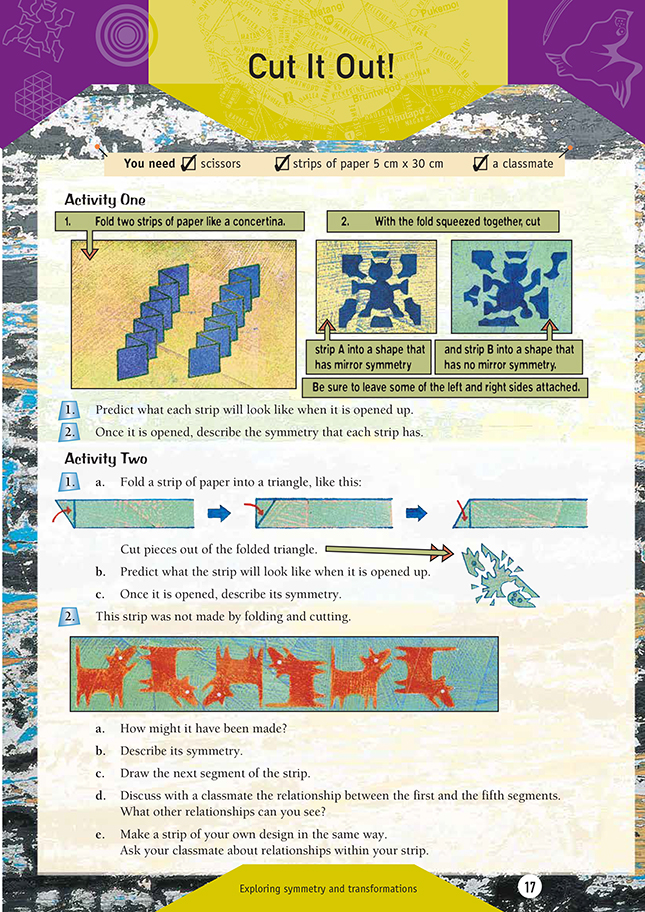
Click on the image to enlarge it. Click again to close. Download PDF (342 KB)
explore symmetry and transformations
strips of paper 5cm x 30cm
scissors
FIO, Level 3-4, Geometry, Cut it Out!, page 17
classmate
Activity One
Using the folding method shown in this activity, the students create a design that has reflective symmetry. They could use a mirror to help them to recognise the lines of symmetry in both their motif and the pattern.
As a follow-up activity, the students could examine friezes (also called strip patterns) for symmetries. Kòwhaiwhai are good examples of friezes. They often have reflective and rotational symmetry and translations. The simplest way for the students to either describe or create a pattern is to identify a basic shape and then look for the different ways by which the shape has been transformed to generate the frieze. There are some photographs of kòwhaiwhai on pages 20 and 21 in School Journal, Part 1
Number 2, 2001.
Activity Two
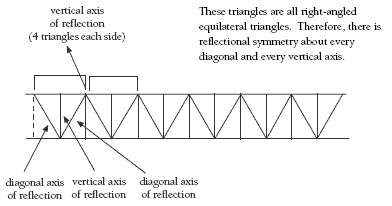
In question 1, the folding technique means that the motif has both diagonal and vertical lines of reflection. The frieze pattern has reflective symmetry only after the motif is repeated four times.
The strip in question 2 uses rotation to create a pattern that is repeated after four rotations of the motif. There is no reflective symmetry in this pattern. So the only symmetry here is rotational symmetry of order 4 and translation symmetry after four moves.
The students may like to use the method described on page 16 of Geometry, Figure It Out, Levels 2–3 to make a block for their own design. Encourage the students to talk about their patterns and the transformations that they have used to create them.
Answers to Activity
Activity One
1. Practical activity
2. Both strips will have reflectional symmetry, but strip A will have twice as many lines of reflectional symmetry as strip B.
Activity Two
1. a. Practical activity
b. Answers may vary, but they should be similar to the answer for c below.
c. The motif has a diagonal line of reflectional symmetry, and the pattern has
repeated vertical lines of reflectional symmetry.
2. a. By repeatedly rotating a printing block and pressing it down next to the previous print.
b. If you consider the four dogs as one region, then that region has been
translated.
c.

d. The first and fifth segments are the same. The first segment has been translated to
the fifth segment. The symmetry is repeated after every four segments.
No matter where you start in the pattern, counting four segments will bring you to
the next point of symmetry.
e. Practical activity