
This is a level 2 measurement strand activity from the Figure It Out series.
A PDF of the student activity is included.
Click on the image to enlarge it. Click again to close. Download PDF (250 KB)
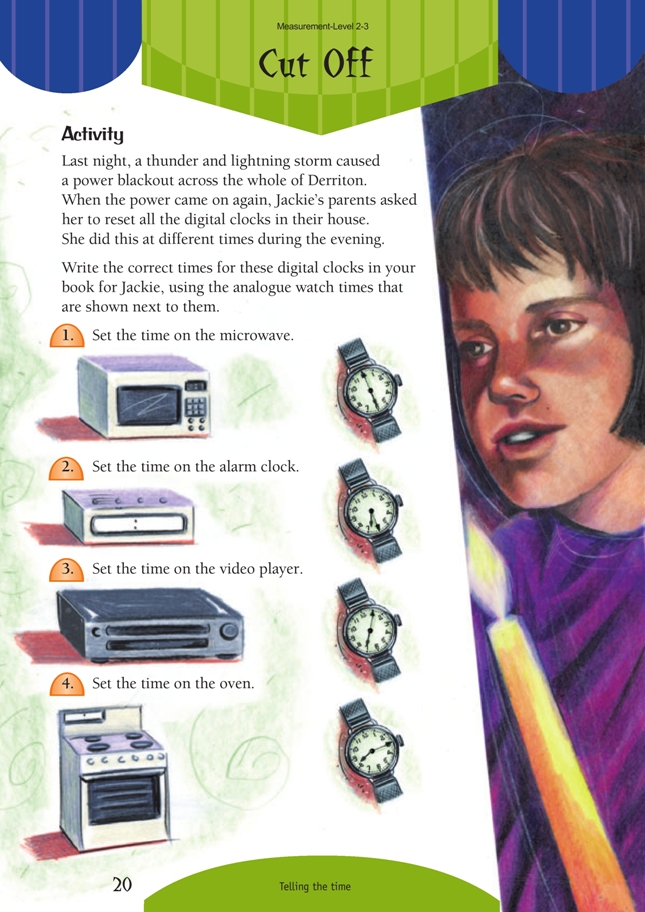
read and write clock times
In this activity, students convert analogue time (clock face with hands) to digital time. Students need to realise that digital time shows minutes past the hour only, and this can cause problems with “to the hour” times, such as “quarter to”.
The activities suggested for page 18 can help students who have difficulty with this aspect of time.
You could use the following example to show that “25 to 7” is the same as “6:35".
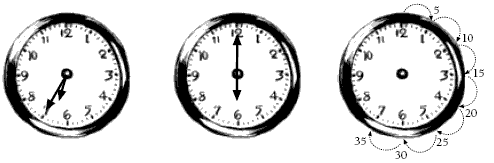
An important point here is that digital time is different from decimal notation. Time is based on 60, due mainly to the ancient Babylonians, who had an annual calendar based on 6 months of 60 days. Decimal notation is based on 10. There is potential confusion here. Consider the decimal 3.59: if hundredths are added, the decimals progress as 3.60, 3.61, 3.62, 3.63 … etc. Time in minutes progresses from 3:59 to 4:00, 4:01, 4:02 … etc. Since digital time is based on 60, times such as 2:63 and 7:98 cannot exist.
Answers to Activity
1. 6:00
2. 6:30
3. 7:05
4. 8:15