
This is a level 3 geometry strand activity from the Figure it Out series.
A PDF of the student activity is included.
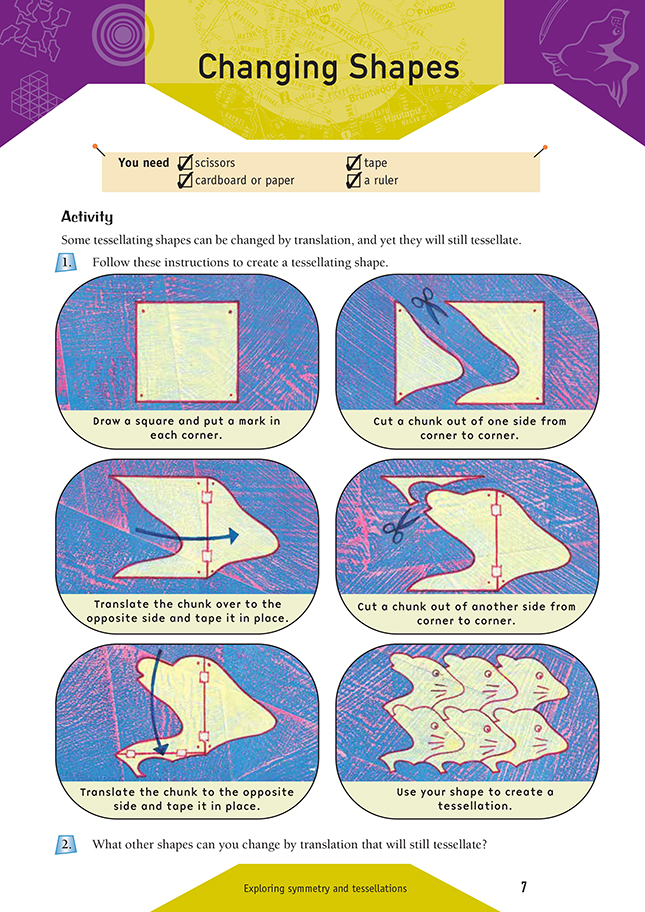
Click on the image to enlarge it. Click again to close. Download PDF (330 KB)
explore symmetry and tessellations
scissors
tape
cardboard or paper
FIO, Level 3-4, Geometry, Changing Shapes, page 7
ruler
This activity gives students a simple method for creating an original tessellating shape. This method is sometimes called the “bite” or “nibble” method. The main rule to follow when changing shapes to create a tessellating tile is that the shape must retain the same area as the original, so each piece that is cut off must be rejoined. Students need to be careful to just translate pieces and not to inadvertently flip them
over.
When they have completed the tile, they translate the tile by sliding it along the plane – up, down, left or right – to create a tessellating pattern. The shape that the students start with must be a polygon in which opposite sides are parallel and congruent because an operation on one side will always affect the opposite side. The square is the easiest shape to start with, but encourage the students to experiment with other
shapes using this bite method. The more sides the polygon has, the more sides that can be altered.
Therefore, starting with a shape such as the regular hexagon can lead to an interesting design.
This activity gives students an opportunity to explore their own artistic creativity. They can add detail to the shapes to give the tessellation added appeal. However, it is important to use this activity not simply as an artistic activity, but as one that gives the students an opportunity to develop an understanding of translation and tessellation and to talk about their creations using the language of geometry.
Under the Sea, Figure It Out, Levels 2–3, page 11 and its accompanying teachers’ notes discuss adapting a triangle to make a whole shape that tessellates.
Answers to Activity
1. Practical activity
2. The shape you start with must be a polygon that has opposite sides parallel and congruent (for example, a rectangle or a regular hexagon).
Your new shape must have the same area as the original shape.