
This problem solving activity has an algebra focus.
The local supermarket creates a display of cans in the shape of a triangle.
The top four rows are shown below.
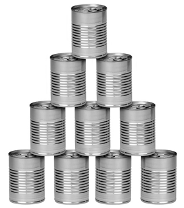
- If the stack has 10 rows, how many cans are on display?
- What if the display is 21 rows high?
- Find a rule for finding the number of cans for any number of rows.
- Find the rule for summing consecutive numbers.
- Identify the pattern of triangular numbers.
- Devise and use problem solving strategies to explore situations mathematically (be systematic, use algebra).
This problem has many methods of solution.
Students may respond to the number patterns at the simplest level, but should be expected to seek an efficient algebraic rule for an arithmetic progression with a common difference of 1. Draw on your students' knowledge of patterns and algebraic rules as you work through the problem.
Alternatively, a geometric approach may be used in which two triangles form a rectangle. This process also informs an algebraic expression.
This problem can introduce or reinforce quadratic equations. At the same time it gives an opportunity to relate a word problem and triangular numbers. Rows of Numbers, Algebra, Level 5 also explores triangular numbers.
The Problem
The local supermarket creates a display of cans in the shape of a triangle. The top four rows are shown below.
- If the stack has 10 rows, how many cans are on display?
- What if the display is 21 rows high?
- Find a rule for finding the number of cans for any number of rows.
Teaching Sequence
- Pose the problem by showing the stacked can display. Ask:
How many cans have been used?
How many cans will be in the next row and how do you know?
Can you see a pattern? How would you write the terms of the pattern down? - Pose the problem to the class.
What strategy could we use to start this problem? (e.g. use a table, guess and check)
Do you remember any other problems that seem like this one? - As the students work on the problem ask questions that focus on the methods they are using to sum the consecutive numbers.
How are you adding the numbers?
Can you think of any other ways that you could add them? Any quicker ways? - Get the students to justify their reasoning by writing a concluding statement to explain their solution.
- Share and discuss solutions including their expressions of the rule.
- Review and discuss the rule if necessary before posing the Extension problem.
Extension
- How many rows would a stack of 136 cans have?
- What would a stack of 432 cans look like?
Solution
There are a number of ways of approaching the first two parts of this question. Two are shown here.
Method 1: Seeing a Pattern
- The number pattern is 1 + 2 + 3 + 4 + ... Each new row gets one more can.
So, in a 10 row stack, there will C = 1 + 2 + 3 + 4 + 5 + 6 + 7 + 8 + 9 + 10 cans. It’s easy to add these up to give a total of 55.
However, it’s useful to try to find a quick way to add numbers in a list like this. This can be done by noticing that certain pairs of numbers add up to 11. For instance, if we add the end pair and the next to end pair and so on, we get
1 + 10 = 11
2 + 9 = 11
3 + 8 = 11
4 + 7 = 11
5 + 6 = 11
Five lots of 11 equal 55, so we get the answer that we got above by straight addition.
- If the display is 21 rows deep, we need to find C = 1 + 2 + 3 + 4 + ... + 18 + 19 + 20 + 21. Again this can be found in two ways: by straightforward addition or by a pairing method. The problem with the pairing is that this time there are an odd number of terms. So we get
1 + 21 = 22
2 + 20 = 22
… …
9 + 13 = 22
10 + 12 = 22
11??
There are clearly 10 lots of 22, and that gives 220. Now add in the 11 to get 231.
- Generalising this method to any number of rows we get C = 1 + 2 + 3 + 4 + ... +(n -1) + n. If n is even we can produce the sum by the usual pairing.
1 + n = n + 1
2 + (n - 1) = n + 1
… … …
r + (n – r + 1) = n + 1
… … …
n/2 + (n/2 + 1) = n + 1.
Each pair adds to n + 1. There are n/2 pairs. Hence the C = n/2 (n + 1).
But what if n is odd? Of course we get the same form of the answer. C = n/2 (n + 1) even if n is odd.
Method 2: A Geometric Approach
First notice that the shape of the stack is a triangle. If we push it a little it becomes a right-angled triangle with the same number of cans. Putting two of these together, the shape becomes a rectangle. This is beneficial as the areas of rectangles are easier to calculate than are the areas of triangles. Begin with four rows.
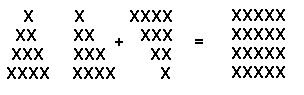
The final rectangle has 20 cans but this is twice as many cans as in the original stack. Hence a four-row stack has 10 cans.
- To use this method in general we need to know the number of rows and the number of cans in the biggest row. So looking at this method for 10 rows we know that the biggest row has 10 cans. You should find that the corresponding rectangle has width 11 (= 10 + 1) and depth 10 (the number of rows). Hence the rectangle has 11 x 10 = 110 cans. The area of the original triangle is half of the rectangle so it is 55 (as we found in Method 1).
- For 21 rows we get a 22 by 21 rectangle with 462 cans. So the original stack has 231 cans (see Method 1).
- In general we have n rows and n + 1 cans in the bottom row. When the two triangles are put together, the width of the rectangle is n + 1 and the depth is n. Hence the area of the rectangle is n (n + 1). This gives the area of the triangular stack as n/2 (n + 1) (see Method 1).
Solution to the Extension
- To find out how many rows 136 cans would occupy, we can guess and check, possibly with the help of a table. To start off we know that the answer is between 10 and 21. So we might guess 15. If there were 15 rows then we would have 15. 16/2 = 120 cans. This isn’t enough, so guess 18 rows. Eventually we could get the answer this way. However, we could also use the formula for the number of cans in a stack with n rows. So we have to solve 136 = n/2 (n + 1). This gives n2 + n – 272 = 0. This factorises to give (n – 16)(n + 17) = 0. This has two solutions but n cannot be -17 so n = 16.
- Using the quadratic method for this part gives n2 + n – 864 = 0. We chose this deliberately so that the quadratic didn’t factorise. It can be solved using the formula to give n = 28.898 or –29.898. What does this mean? The closest stack that we could have is a stack with 29 rows. However, there are not quite enough cans for such a stack. So there are a few cans missing off of the top. How many are missing?