
Te Kete Ipurangi Navigation:

Te Kete Ipurangi
Communities
Schools

Te Kete Ipurangi user options:


Level One > Number and Algebra

Buttons and Frames

Purpose: 

This activity is to allow students to explore all the combinations to ten.  These are necessary facts to come to know as they are used as a base to derive other facts from.  For example 8 + 4 = .  I know 8 + 2 = 10 there’s 2 more so it’s 12

Achievement Objectives:

Specific Learning Outcomes: 

name the combinations to 10.

Required Resource Materials: 
Beans, buttons or counters that are one colour on one side and a different colour on the reverse.
Activity: 
  1. Flash a ten frame at the students and then hide it.  Ask students;
    How many dots did you see? 
    How many more would you need to make 10? or
    How many gaps are there?
  2. Check by showing the students the ten frame again.  Flash a different one.  This is to encourage students to image these patterns in their head without having to count the individual dots.
  3. Put students into pairs or small groups of 3 or 4.  Each group of students will need a set of ten counters coloured different colours on each side and two blank ten frames. 
  4. Students can take turns to shake the counters and empty them onto the floor in front of them.  The counters are then sorted into the 2 colours and placed on the 2 ten frames.
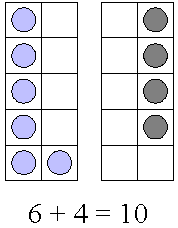
    diagram.

  5. Students can record the number sentence on a piece of paper.

Similar Resources

Facts to 10

Count a set of objects in the range 1–10.

Instantly recognise patterns to 10, including finger and tens frame patterns.

Instantly recognise patterns to 10 including doubles.

Recall the facts up to 10, and the teen facts.


Using Tens Frames for "Teen" Numbers

The purpose of this unit is to recognise and understand teen numbers.  This is an essential piece of knowledge for the part-whole strategy of bridging to ten.

Using Tens Frames to Build the Addition and Subtraction Facts to Ten

The purpose of this unit is to build and consolidate the addition and subtraction facts to ten.  These addition and subtraction facts are building blocks for part-whole thinking.

Using Tens Frames to Build the Basic Facts of Five

The purpose of this “unit” is to introduce addition facts to five.  It is important for students to have concrete experiences using a variety of contexts to build their knowledge of the basic facts of five.  They need to become secure in this knowledge to enable them to build on these known facts in future learning.

Fizzing It Up

This is a level 2 number activity from the Figure It Out series. It relates to Stage 5 of the Number Framework.