
Building Teens
In this activity the students use their knowledge of tens frames to reinforce their knowledge of teen numbers. The activity encourages the students to notice the different combinations they are able to make.
Group and regroup to make teen numbers.
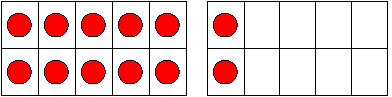
- Use two tens frames and say
How would you arrange 12 counters on the frames? How did you decide to show 12 this way? - Then ask the group.
What do you notice about the counters on the frames?
Encourage a variety of responses. - Ask other students to show 12 in different ways.
- Use other teen numbers each time, and repeat the questions.
Similar Resources
Teen numbers
In this activity students learn that the code in English for numbers from 13 to 19 the "teen" part of the words means ten.
Facts to 10
Count a set of objects in the range 1–10.
Instantly recognise patterns to 10, including finger and tens frame patterns.
Instantly recognise patterns to 10 including doubles.
Recall the facts up to 10, and the teen facts.
Using Tens Frames for "Teen" Numbers
The purpose of this unit is to recognise and understand teen numbers. This is an essential piece of knowledge for the part-whole strategy of bridging to ten.
Squeeze - Guess my Number
Order numbers in the range 0–100.
Order the numbers in the range 0–1000.
Order whole numbers in the range 0–1 000 000.
Read decimals with tenths, count forwards and backwards in tenths, order decimals with tenths.
Identify and order decimals to three places.
Number Line Flips
Say the forwards and backwards number word sequences in the range 0–10.
Say the forwards and backwards number word sequences in the range 0–20.
Order the numbers in the range 0–20.
Order numbers in the range 0–100.
Order the numbers in the range 0–1000.
Order whole numbers in the range 0–1 000 000.
Read decimals with tenths, count forwards and backwards in tenths, order decimals with tenths.
Identify and order decimals to three places.


