
This is a level 2 number activity from the Figure It Out series. It relates to Stage 5 of the Number Framework.
A PDF of the student activity is included.
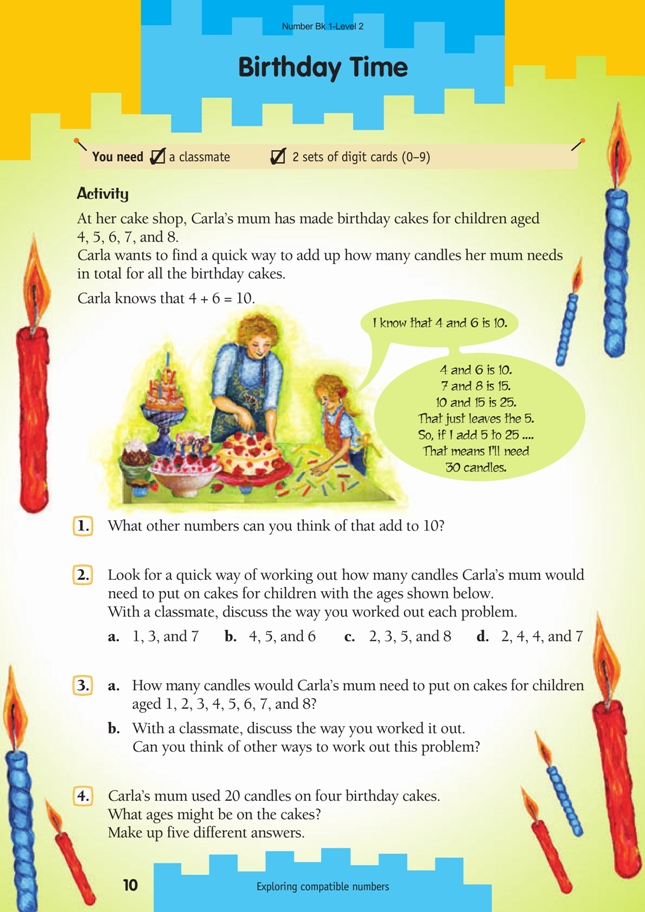
Click on the image to enlarge it. Click again to close. Download PDF (219 KB)
use compatible numbers to 10 to solve addition problems
- 2 sets of Numeral cards
- FIO, Level 2, Number, Book 1, Birthday Time, page 9
- classmate
Adding three or more single-digit numbers by looking for numbers that make 10 is the focus of this activity. If the students simply added the numbers in the order in which they were presented, they would do something like this:
4 and 5 is 9, and 6 more is 15, and 7 more is 22, and 8 makes 30.
Scanning the list of numbers for two or sometimes three numbers that add to 10 is a strategy that might help the students to solve problems like these more efficiently. This also reinforces their knowledge of groupings within 10, which they should know at this level.
Question 1 serves to remind the students of the combinations of numbers that make 10. Encourage the students to move beyond basic facts here by asking “How many combinations of three numbers can you think of that make 10?”
In questions 2 and 3, the students should be applying this knowledge of groupings within 10 to make the addition easier. In question 2c, there are two ways of grouping the numbers to make 10, that is: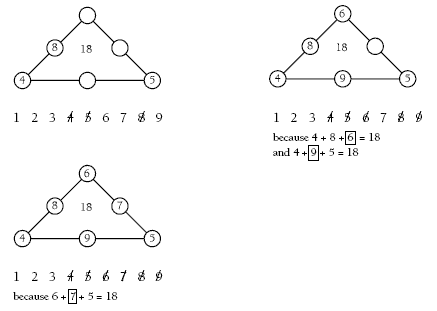
Demonstrate how the students could arrange the digit cards into groups of numbers that make 10.
The answers given to question 4 all use single-digit numbers. The students may well find solutions that include a two-digit number, for example, 10, 5, 3, and 2 or 12, 4, 3, and 1.
This question could be extended by increasing the number of candles, for example, to 30, and instructing the students to use at least one two-digit number in their solutions.
This activity uses the associative property of addition, that is, the order in which the numbers are added does not alter the sum. Ensure that the students understand that this property applies regardless of whether two, three, four, or more numbers are being added. You could model adding four numbers using concrete materials, for example, counters, beans, or cubes, to demonstrate this.
It’s important that you help the students to build up a range of mental strategies and that they do not become totally reliant on any one strategy to tackle all problems. For instance, although using doubles and near doubles is a useful addition strategy, it is not so useful with a question like 1 + 3 + 7. The students need to be able to select, from a range of strategies, the best strategy for a particular problem.
Answers to Activity
1. 1 + 9, 2 + 8, 3 + 7, 5 + 5
2. a. 11 candles
b. 15 candles
c. 18 candles
d. 17 candles
3 a. 36 candles
b. Practical activity, but a quick way is to regroup in pairs that make 10, for example,
2, 8; 3, 7; 4, 6 then add 5 and 1.
4. Answers will vary. Some examples are:
5, 5, 5, 5
4, 5, 5, 6
1, 3, 7, 9
2, 4, 6, 8
2, 3, 7, 8