
This is a level 5 geometry strand activity from the Figure It Out series.
A PDF of the student activity is included.
Click on the image to enlarge it. Click again to close. Download PDF (242 KB)
investigate ratios when enlarging
FIO, Level 4+, Geometry, Book Two, Ancient Architectrue, page 22
calculator
computer
In ancient Greece, it was believed that, of all possible rectangles, the golden rectangle had the most pleasing proportions. Its proportions were often used in works of art and architecture. The golden rectangle is still used in art today, but authorities no longer agree that it has the perfection that was once claimed.
Mathematics in the New Zealand Curriculum suggests, as a level 4 development band activity, that students research and report on the use of geometrical ideas in art, "for example: the occurrences of the golden section in art and architecture".
Activity
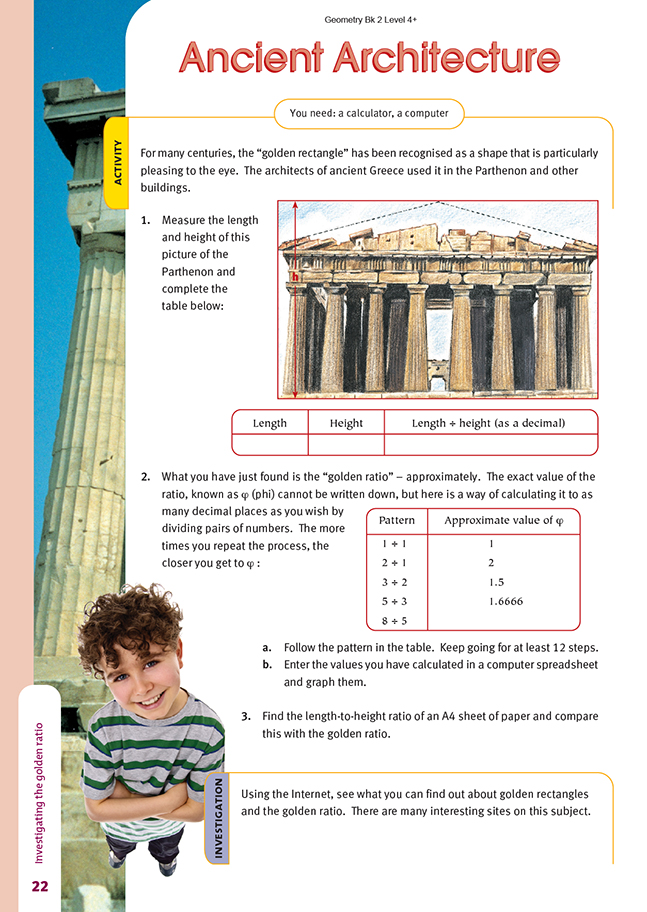
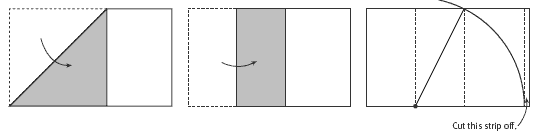
In question 1, the students measure the length and height of an illustration of the Parthenon. Alternatively, they could construct a golden rectangle and take measurements directly from this. The construction is quite straightforward, but the students will need to use a compass. The diagram shows how to start with any
rectangle and, by folding, drawing, and cutting, to reduce it to the correct proportions.
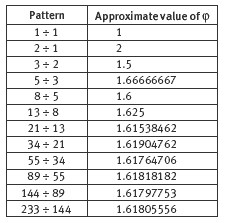
Question 2a asks the students to follow a pattern that will lead to an increasingly precise value for j. Some may be intrigued about the nature of this number. Like p, j is irrational. For a discussion on irrational numbers, see page 12 of the teachers' notes for Measurement: Book One, Figure It Out, Years 7-8.
When doing question 2b, the students should enter the values from the second column of their table in a spreadsheet and then select the XY (scatter) option.
The students may be interested to see that the value of the golden ratio, correct to 50 places, is:
1.618Ê033Ê988Ê749Ê894Ê848Ê204Ê586Ê834Ê365Ê638Ê117Ê720Ê309Ê179Ê805Ê76.
The students can compare the proportions of an A4 sheet with those of the golden rectangle (question 3) either by calculation or by following the steps in the diagram above. If they measure the A4 sheet, then divide length by breadth, they should get a result of 1.41, correct to 2 decimal places. This is well short of the value of j. The 1.41 value is not chosen at random. It is √2 (the square root of 2, which is another irrational number). A rectangle whose sides are in the ratio of √2:1 can be halved to give 2 smaller rectangles whose sides are in exactly the same ratio as those of the original rectangle. That is why all sheets in the series A1, A2, A3, A4... have the same shape.
Investigation
The students investigate the golden rectangle and the golden ratio, using the Internet. The following is a good sites\ to begin with:
http://mathforum.org/dr.math/faq/faq.golden.ratio.html
Answers to Activity
1.
 1.
1.
2a.
3. 297 ÷l; 210 = 1.41. Although this number looks quite close to the golden ratio, the difference is enough to give a rectangle with very different proportions.
Investigation
Practical activity