
This is a level 3 and 4 algebra strand activity from the Figure It Out series.
A PDF of the student activity is included.
Click on the image to enlarge it. Click again to close. Download PDF (230 KB)
generalise that repeated addition equates to multiplication
use a rule to describe a pattern
classmate
Activity One
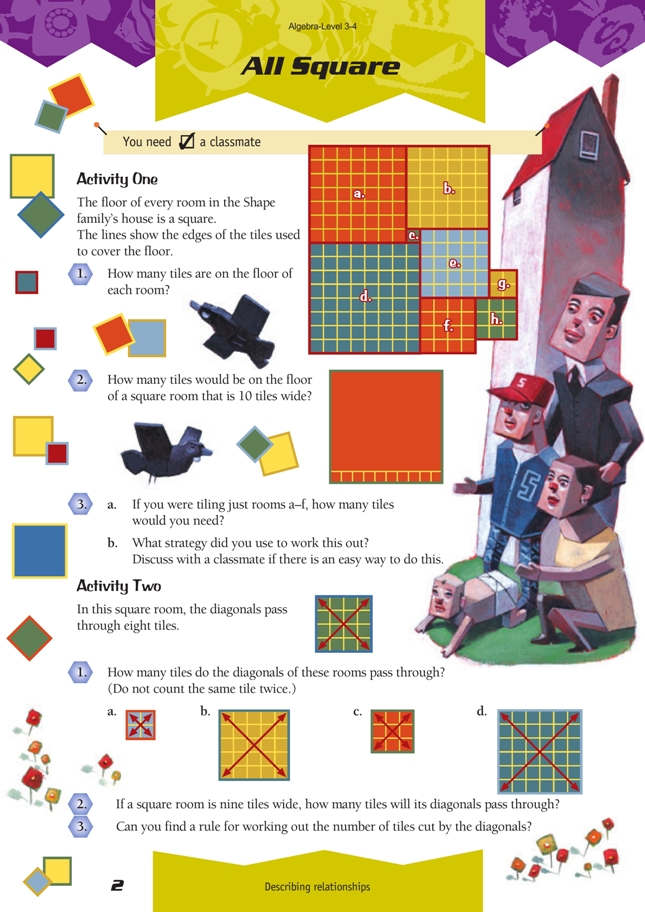
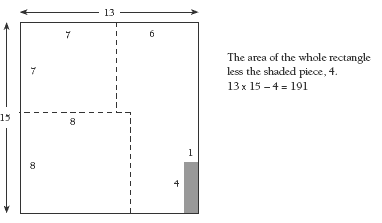
For questions 1 and 2, the students should use multiplication to find the number of tiles in each room rather than counting by ones or equal additions. In question 3, looking at geometric patterns is more effective than just working with the numbers. As shown on the diagram on the following page, the students can find the sum of the tiles needed for rooms a–f by finding the area of the whole rectangle and subtracting the shaded piece (4). 13 x 15 – 4 = 191. So you would need 191 tiles for a–f. This is shown as a diagram on the next page.
If the students do decide to add the room totals, they could simplify the task by looking for tidy pairs of numbers. Putting the numbers in order may help.
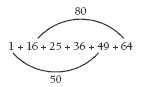
So the problem becomes: (50 + 80) + (25 + 36) = 130 + 61 = 191.
Activity Two
The students will need to see that the number of tiles a diagonal line passes through is the same as the number of tiles along any side.
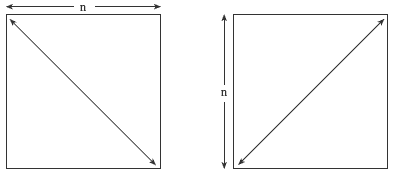
If n is even, the diagonals cross 2n squares:
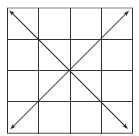
But if n is odd, one square is crossed twice, so the rule is 2n – 1.
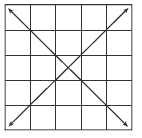
For example in room b, which is 6 x 6, the diagonals will cross 2 x 6 = 12 tiles because 6 is even. For a 9 x 9 room, the number of diagonals cut will be (2 x 9) – 1 = 17
Answers to Activities
Activity One
1. a. 49
b. 36
c. 1
d. 64
e. 25
f. 16
g. 4
h. 9
2. 100
3. a. 191
b. Answers will vary. Many students will add up their a–f answers from question 1.
An easier way is to look at a–f as a rectangle (by adding four tiles). To find the answer, multiply length x width – 4. This will be 13 x 15 – 4 = 191.
Activity Two
1. a. 4
b. 9
c. 5
d. 12
2. 17
3. Even-numbered width: number of tiles in width x 2
Odd-numbered width: (number of tiles in width x 2) – 1