
This problem solving activity has a number and algebra (patterns and relationships) focus.
Jim has ten tiles with one of the numbers 0, 1, 2, 3, 4, 5, 6, 7, 8, and 9 on each of them.
He plays around and discovers that he can make some addition sums like the one below.
The four digits in the sum always seem to add up to 18.
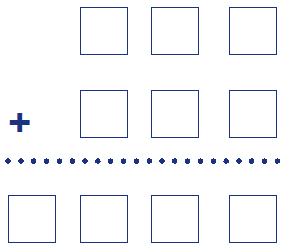
How many answers like this can Jim make?
- Use the numbers facts with digits to solve a problem.
- Devise and use problem solving strategies to explore situations mathematically (guess and check, be systematic, look for patterns, think, use algebra).
This problem involves students in using basic number facts and experimentation to find a number combination solution, and in using algebra to solve the extension to the problem.
It would be an advantage if students have first solved the problem Adding Ten Tiles I (Level 5) as the method used can also be applied to this problem.
The Problem
Jim has ten tiles with one of the numbers 0, 1, 2, 3, 4, 5, 6, 7, 8, and 9 on each of them. He plays around and discovers that he can make some addition sums like the one below. The four digits in the sum always seem to add up to 18.
How many answers like this can Jim make?
Teaching Sequence
- Pose the problem to the students. Check that they understand that there are ten different numbers (0 to 9 inclusive) that each must be used.
- As a class, have the students guess at first and record their answers on the board as they find them. For students who seem to be stuck, ask:
Where do you think the number 1 goes? Why?
What four numbers add up to 18? So what could just the answer to Jim’s sum be? - As groups work on the problem, and begin to guess a few answers ask:
Have you checked the addition for your answer?
How did you get the answer? - When two different addition answers with the same digits in the sum have been found ask
What are the similarities between these answers?
Can you get another addition sum using the same numbers? How many? - When a number of answers have been found, discuss as a class:
Have we got all of the possible answers?
How will we know when we have all of the answers? - When the class realises that there are a number of ways of getting 18, split these ways amongst the different groups. This will speed up the process of finding the overall answers.
- Ask some of the groups to explain what they have done. Get all groups to write up the problem as far as they were able to go, giving reasons for what they have done.
Extension
Jessica has been working on Jim’s problem in Adding Ten Tiles II. She wants to know if there are any sums that have four-digit answers that don’t add up to 9 or 18. Can you help her?
Solution
Begin by guessing and checking. The full set of answers is:
| 3 2 4 | 3 4 2 | 4 3 2 | 4 2 3 | |||
| 7 6 5 | 7 5 6 | 6 5 7 | 6 7 5 | |||
| 1 0 8 9 | 1 0 9 8 | 1 0 8 9 | 1 0 9 8 | |||
| (i) | (ii) | (iii) | (iv) |
The complete solution for Jim’s problem is as follows.
Step 1: The first thing to notice is the value of the left-most digit in the answer. It couldn’t be 0 as then the answer wouldn’t be a four-digit answer. In that case we’d be looking at the problem Nine Tiles.
Now to get that digit we have to add two other digits plus a possible carry-over from the tens column. The biggest two digits we could have are 8 and 9. The carry-over cannot be bigger than 2. The sum of 8 and 9 and 2 is 19, which is less than 20. So the carry-over from the hundreds column is 1. This is the value of the left-most number in the answer.
Step 2: So now we have to decide what three digits plus 1 add up to 18. Working systematically we get: 9, 8, 1, 0; 9, 6, 2, 1; 9, 5, 3, 1; 8, 7, 2, 1; 8, 6, 3, 1; 7, 6, 4, 1 (other possibilities don’t include 1 or contain repeated digits).
Step 3: 9, 8, 1, 0. To get the answers to this question we need to go through all of the various answer digit combinations. We’ll start with 9, 8, 1, 0. Remember that 1 is the left-most digit. Since 9 and 8 are used in the answer to the sum they can’t be used for the addends (the numbers that are being added together). So 9 and 8 can’t be in the hundreds position.
So we are looking at 1089 or 1098. We’ll do 1089 in full and leave 1098 to you.
First notice that there are no carry-overs in the units or tens columns as we do not have big enough digits left to add to 19 or 18, respectively. So we’ll concentrate on the hundreds column. How can we get 10? The only two possibilities are 3 and 7 and 4 and 6. Any other possibilities include digits that have been used already or repeated digits.
Let’s go with 3 and 7. To get a 9 in the units position we need to add 2 and 7, 3 and 6 or 4 and 5. But the only legal one of these is 4 and 5. At this stage the only two digits left are 2 and 6. Fortunately they give us the 8 that we need. So the Jim’s answer that we get here is (i) or some rearrangement of the numbers in the columns making up the addends.
Now if we try 4 and 6, we have to use 2 and 7 in the units column and 3 and 5 in the tens column. This gives us (iii) or some slight rearrangement of it.
As we said, we’ll leave 1098 to you but you should get (ii) and (iv) using the method above.
Step 4: 9, 6, 2, 1. As above 9 can’t be the hundreds digit of the answer. So we have to have 1269, 1296, 1629 or 1692.
Consider 1269. We can get 9 by adding 0 + 9, 1 + 8, 2 + 7, 3 + 6 or 4 + 5. The last one is the only legal sum. To get 6 we need 0 + 6, 1 + 5 or 2 + 4. But none of these is legal and so 1269 can’t be one of Jim’s answers.
Consider 1296. To get 6 we would need 0 + 6, 1 + 5 or 2 + 4. None of these is legal.
Consider 1629. The only legal way to get 9 is 4 + 5. To get 2 we need 0 + 2 or 1 + 1 but neither is legal.
Consider 1692. To get 2 we need 0 + 2 or 1 + 1 but neither is legal.
Step 5: 9, 5, 3, 1. Once again we can only have 1359, 1395, 1539 or 1593 as we can’t have 9 in the hundreds position.
Consider 1359 and 1395. In both cases there are no carry-overs for the 5. To get 5 we need 0 + 5, 1 + 4 or 2 + 3, none of which are legal.
A similar argument applies to the 3 in 1539 and 1593.
Step 6: 8, 7, 2, 1. Arguing as we did before on the 9, 8 can’t be in the hundreds column and neither can 7. So we are left with 1278 or 1287. Now 9 can’t be in the units or hundreds column of an addend in either case as there is no digit left that will take it up to 17 or 18.
To make 7 we need 0 + 7, 1 + 6, 2 + 5 or 3 + 4 and to make 8 we need 0 + 8, 1 + 7, 2 + 6 or 3 + 5. For 7, 3 + 4 is the only legal possibility while for 8 it’s 3 + 5. This would require the use to two 3s.
Step 7: 8, 6, 3, 1. Again 8 can’t be in the hundreds position.
Consider 1638 and 1683. To get 6 in the hundreds position we’d need 9 + 7 and no carry-over (9 + 6 and 8 + 7 are illegal). But 3 has to have a carry over since 0 + 3 and 1 + 2 are illegal. That rules out 1638. To get 13 we need 6 + 7, 5 + 8 or 4 + 9. None of these is legal.
Step 8: 7, 6, 4, 1. As above 7 can’t be the hundreds digit. To get 6 there we’d need 9 + 7 but that isn’t possible. So we reduce the possibilities to 1467 or 1476. By what we have just said, neither the 6 nor the 7 can be associated with a carry-over. So 6 = 2 + 4, while 7 = 2 + 5 or 3 + 4. These conditions are incompatible so tis case is complete.
Step 9: In summary we only have the four answers to Jim’s problem listed at the start of this solution. To remind you they are:
| 3 2 4 | 3 4 2 | 4 3 2 | 4 2 3 | |||
| 7 6 5 | 7 5 6 | 6 5 7 | 6 7 5 | |||
| 1 0 8 9 | 1 0 9 8 | 1 0 8 9 | 1 0 9 8 | |||
| (i) | (ii) | (iii) | (iv) |
Of course there is also the possibility of moving digits vertically up and down above the horizontal line. This will give 32 answers altogether.
Solution to the Extension
There are clearly some patterns in the above answers that should be useful. Use algebra and see what happens.
First note that the left-hand digit of the bottom row has to be 1 as the numbers are not big enough for it to be any larger (we also ignore the possibility of this number being 0 as that would take us back to the Nine Tiles problem).
Suppose that we have an answer of the form:
| a b c |
| d e f |
| 1 h i j |
Now c + f = j or 10 + j, b + e or b + e + 1 = i or 10 + i, and a + d or a + d + 1 = 10 + h. Assuming that there are r carry-overs, where r = 1, 2 or 3, we can add these equations up to get
a + b + c + d + e + f + (r – 1) = 10r + h + i + j
[45 – (1 + h + i + j)] + (r – 1) = 10r + h + i + j
44 + (r – 1) – 10r = 2(h + i + j)
This means that r has to be odd, so r = 1 or 3.
If r = 1: Then 44 – 10 = 2(h + i + j). So h + i + j = 17.
Now where can the zero be? It can’t be b, e, c or f as that would mean that we would need to repeat one of these numbers in the answer. Suppose that it is a. Then a + d has to carry over. But this is not possible as 0 + d can never be bigger than 9 (remember there is no carry over from the tens column). So one of h, i or j has to be zero. The only way that three numbers can add to 17, where one is zero, is for the numbers to be 9, 8 and 0.
The zero has to be h as a + d can never be 18 or 19 (without a carry-over). This means that the number in the bottom line has to be 1089 or 1098. So we have to get 8 and 9 without carry-overs and two numbers have to add to 10. We put down all the relevant sums that don’t use 0, 1, 8 or 9.
8 = 2 + 6 = 3 + 5; 9 = 2 + 7 = 3 + 6 = 4 + 5; 10 = 3 + 7 = 4 + 6.
If 8 = 2 + 6, then 9 = 4 + 5 and 10 = 3 + 7. This gives us the answers (i) and (ii).
If 8 = 3 + 5, then 9 = 2 + 7 and 10 = 4 + 6. This gives us the answers (iii) and (iv).
| (i) | 324 | (ii) | 324 | (iii) | 432 | (iv) | 423 |
| (v) | 437 589 1026 | (vi) | 347 859 1206 | (vii) | 473 589 1062 | (viii) | 743 859 1602 |
| (ix) | 246 589 1035 | (x) | 426 879 1305 | (xi) | 264 789 1053 | (xii) | 624 879 1503 |
If r = 3: Then 16 = 2(h + i + j). So h + i + j = 8.
Now 8 can be made using three digits, none of which is 1, in only the following two ways:
8 = 0 + 2 + 6 = 0 + 3 + 5.
So the number in the bottom line has to be 1026 (or 1 and some permutation of the last three digits) or 1035 (or 1 and some permutation of the last three digits).
Let’s try 1026. Then we need to get 16 by adding two digits. This can be done using 9 + 7 only. So c, f are 7, 9 in any order. To get 12 in the tens column we have the carry-over so we must get 11. This can be done using 6 + 5 or 7 + 4 or 8 + 3 or 9 + 2. But each of those pairs has had one number used already except 8 + 3, so b, e are 3, 8, in some order. Finally to get 10 including the carry-over we have to have two digits sum to 9. Now 9 = 4 + 5 = 3 + 6 = 2 + 7. Using 4 and 5 for a and d we obtain answer (v). Note that we can interchange the tens and hundreds column to give answer (vi).
Proceeding in this way we can look at 1062 (which leads to answer (vii) and (viii)) and 1260 (for which there is no answer, nor is there one for 1620). Hence we produce four answers.
Now turning to 1035 and its permutations we gather the remaining four answers.
A successful non-algebraic approach, or a more efficient way of doing the problem is desirable. Can you find one?