
This problem solving activity has a number focus.
Jim has ten tiles with one of the numbers 0, 1, 2, 3, 4, 5, 6, 7, 8, and 9 on each of them. He plays around and discovers that he can make some addition sums like the one below.
What’s more, the four numbers on the tiles in the answer to the sum (the numbers in the bottom row), add up to 9.
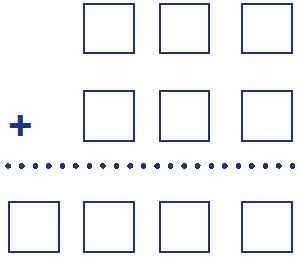
How many sums like that can he make?
- Use known numbers facts with digits to solve a problem.
- Use a systematic approach to get the number of ways that four numbers can add to 9.
Whilst students are likely to use a trial and error approach at the outset, ultimately they will need to be systematic in the way that they produce an answer sum (of 9), and in the way that they find combinations.
This problem links strongly to the Level 6 Number and Algebra - Patterns and Relationships problems Adding Ten Tiles II and Nine Tiles.
- Copymaster of the problem (Māori)
- Copymaster of the problem (English)
- Ten tiles, cards, or pieces of paper with the numbers 0 to 9 on them
The Problem
Jim has ten tiles with one of the numbers 0, 1, 2, 3, 4, 5, 6, 7, 8, and 9 on each of them. He plays around and discovers that he can make some addition sums like the one below. What’s more, the four numbers on the tiles in the answer to the sum (the numbers in the bottom row), add up to 9.
How many sums like that can he make?
Teaching Sequence
- Pose the problem and check that the students understand that each of the ten different numbers (0 to 9 inclusive) must be used.
- As students work ask:
Where do you think the number 1 goes? Why?
What four numbers add up to 9? So what could just the answer to Jim’s sum be? - For groups that have managed to guess a few answers ask:
Have you checked the addition for your answer?
How did you get the answer?
How could you prove that your answer is correct? - When two different addition answers with the same digits in the sum have been found ask
What are the similarities between these answers?
Can you get another addition sum using the same numbers? How many? - When a number of answers have been found, have students share these with the class. Ask
Have we got all of the possible answers?
How will we know when we have all of the answers? - Have students write up the problem as far as they were able to go, giving reasons for what they have done.
- Have some groups share and explain what they have done.
Extension
Show that you have found all possible answers to Jim’s problem.
Solution
A guess and check strategy is likely to be used initially. However, the full set of answers is:
| 4 3 7 | 3 4 7 | 4 7 3 | 7 4 3 | |||
| 5 8 9 | 8 5 9 | 5 8 9 | 8 5 9 | |||
| 10 2 6 | 12 0 6 | 1 0 6 2 | 1 6 0 2 | |||
| (i) | (ii) | (iii) | (iv) | |||
| 246 | 426 | 264 | 624 | |||
| 789 | 879 | 789 | 879 | |||
| 1035 | 1305 | 1053 | 1503 | |||
| (v) | (vi) | (vii) | (viii) |
An algebraic and/or a systematic approach will enable us to be sure these are the only possible solutions.
The algebraic solution is shown in Adding Ten Tiles II
The steps in the systematic approach are:
Step 1: First notice the value of the left-most digit in the answer. It can’t be 0 as then the answer wouldn’t be a four-digit answer.
To get that digit we have to add two other digits plus a possible carry-over from the tens column. The biggest two digits we could have are 8 and 9. The carry-over cannot be bigger than 2. The sum of 8 and 9 and 2 is 19, which is less than 20. So the carry-over from the hundreds column is 1. This is the value of the left-most number in the answer.
Step 2: To get an answer whose digits, one of which is 1, add up to 9 we have to find three different digits whose sum is 8. Doing this systematically we get the following two possibilities: 6, 2, 0; 5, 3, 0. (Remember that 5, 2, 1 is not possible, as we have already used up the 1.)
The answer to the Jim’s sum might be 1026, 1062, 1206, 1260, 1602, 1620 or 1035, 1053, 1305, 1350, 1503, 1530.
Step 3: Getting the answers. Let’s try 1026 first. To get a 6 the only combination that will work is 7 + 9. (0 + 6, 1 + 5, 2 + 4, 3 + 3, 8 + 8 won’t work for various reasons – either we have already used up one of the digits in the sum or the same digit is needed twice.) How do we get a 2? Well it’s really 1 because we have a carry-over of 1 already. The only way is 3 + 8. Then we have to find two digits that with 1 give 10. So we want two digits whose sum is 9. But the only digits we haven’t used yet are 4 and 5 and they fit. So we get the answer (i) from above or various combinations like:
| 4 3 9 | 4 8 9 |
| 5 8 7 | 5 3 7 |
| 1 0 2 6 | 1 0 2 6 |
To make things simpler we will agree that they are all equivalent because once we have one we can then get all the others just by moving the numbers around.
Working with the other four-digit answers we get the eight answers we listed above, give or take the variations we’ve already seen in the columns for 1026.
Step 4: There are 8 answers to Jim’s problem (or 64 if you count all the different equivalent answers).
Solution to the Extension
Note that in doing the solution to Jim’s problem carefully and systematically, we have answered the Extension problem too.