
Use multiplication to solve addition and subtraction problems.
Number Framework Stage 7
The famous mathematician Carl Friedrich Gauss was asked as a five year old to work out 1 + 2 + 3 + ... + 99 + 100. He almost instantly replied the answer was 5050. How could he have got the answer so fast?
Using Materials
This is the method Gauss used to add up the numbers 1 to 10.
Place cards from 1 to 10 in order

Place 10 under 1, 2 under 9, and so on.
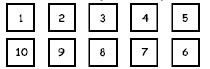
Discuss the total of each pair. (Answer: it is 11.)
Discuss why the total is 5 x 11 = 55. (Answer: There are 5 pairs each adding to 11.)
Repeat for 1 + 2 + 3 + 4 + ... + 8, 1 + 2 + 3 + 4 + ... + 12, 1 + 2 + 3 + 4 + ... + 14
Using Number Properties
Solve Gauss’ problem: 1 + 2 + 3 + 4 + ... + 98 + 99 + 100.
(Answer: 1 and 100 = 101, 2 and 99 = 101 ... So the series adds up to 50 _ 101 = 5050.)
Repeat for 1 + 2 + 3 + 4 + ... + 999 + 1000,
1 + 2 + 3 + 4 + ... + 46,
1 + 2 + 3 + 4 + ... + 88.
Understanding Number Properties:
Find a formula for 1 + 2 + 3 + 4 + ... + 2 n. (Answer: n(2n + 1).)