
This problem solving activity has an algebra focus.
 Tia and Tom are twins. Tia saves and Tom spends.
Tom finds a $20 note on Sunday evening and spends $2 a day starting on Monday.
Coincidentally, Tia starts work on Monday and gets $2.50 a day.
How long will it be before Tia has more money than Tom?
- Use a graph to describe a rule for continuing a number sequence.
- Use a graph to compare two number sequences.
- Devise and use problem solving strategies to explore situations mathematically (guess and check, be systematic, make a drawing).
This problem involves students finding a mathematical solution for a practical problem. This can be done in a number of ways, including guess and check, and using a table. However, both a graphical approach and an algebraic one are explored in more depth here. This is done to enable students to see the value of these approaches, and how they can be effectively applied to other situations. To work successfully with this problem, your students should have some knowledge of working with continuous number sequences, linear rules graphs, and tables.
- Graph paper or software
- Copymaster of the problem (English)
- Copymaster of the problem (Māori)
The Problem
Tia and Tom are twins. Tia saves and Tom spends. Tom finds a $20 note on Sunday evening and spends $2 a day starting on Monday. Coincidentally, Tia starts work on Monday and gets $2.50 a day. How long will it be before Tia has more money than Tom?
Teaching Sequence
- Pose the problem to the class. Ask students to think whether they are savers like Tia or spenders like Tom.
- Brainstorm for ways to solve the problem – list these on the board for the students to refer to as they solve the problem. Encourage students to think of systematic methods (e.g. using a table, creating a graph).
- As the students work on the problem (in pairs) ask questions that focus on the strategy they have selected:
What approach are you using?
Why did you select that approach?
Are you making progress? - Encourage the students to record their solutions in ways that clearly show what they did.
- Display and share written solutions.
- If no solutions include a graphical representation, share and discuss this with the students.
- Have students suggest an algebraic solution, if this approach has not been shared already. Explore their ideas (which may include the equation shown in the solution).
- Pose the extension problem as appropriate, challenging students to show their own problem and solution using a graph or algebra.
Extension
Write your own twins problem for others to solve.
Solution
In the graph below, we sketch the situation. Diamonds represent Tom’s finances and squares represent Tia’s situation.
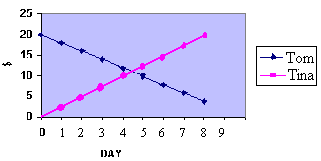
From the graph we can easily see that the small squares go above the crosses on day 5, Friday. So it is five days until Tia has more money than Tom.
Solution to the Extension
To do this algebraically we first have to find out the two rules for the number patterns produced by Tom and Tia’s activity. We can use the letter n to represent the number of days surpassed, and M to represent the total amount of money. Tom began with $20 and then spent $2 a day. So each day he had $2 less. His equation is
M = 20 – 2n
Tia earns $2.50 each day and so her equation is
M = 2.5n
Check these equations work by putting in actual values for n.
If the two Ms can ever be equal we will have:
2.5n = 20 – 2n, which becomes 4.5n = 20, so n is 4 and a bit.
If they are equal after 4 and a bit days, then one of them must have more for the first time on day 5. Since Tia’s money is increasing, she is just ahead on day 5.