
These are level 3 number problems from the Figure It Out series.
A PDF of the student activity is included.
Click on the image to enlarge it. Click again to close. Download PDF (311 KB)
find fractions of whole numbers (Problems 1 and 2)
use addition and systematic approach to solve problems (Problem 3)
Problem One
Trial and improvement is one strategy that the students might use, but it is inefficient. The students will probably find the answer more quickly by working backwards:
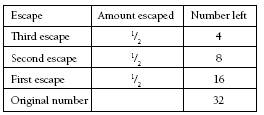
Felicity ended up with four goats. She lost half in the third escape. So she must have had 2 x 4 = 8 before that.
Half escaped the second time, so she must have had 2 x 8 = 16 before that.
And half escaped the first time. So she must have had 2 x 16 = 32 at the start.
These results could be recorded in a table:
A double number line could also be used to solve the problem.

Four goats were left on Monday, which was one-eighth of the herd, so the starting number of goats must have been 4 x 8 = 32.
Problem Two
This problem gives the students practice in finding fractions of whole numbers (which is the same as multiplying fractions and whole numbers, for example 1/2 x 8). The problem is straightforward as long as they accurately calculate the fractions. Drawing a diagram will help them visualise the problem.
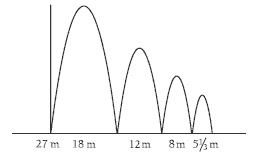
One simple way of working out the problem is:
1/3 of 27 = 9, so 2/3 = 18.
1/3 of 18 = 6, so 2/3 = 12.
1/3 of 12 = 4, so 2/3 = 8.
1/3 of 8 = 2 2/3, so 2/3 = 5 1/3.
So the ball bounces to a height of 51/3 metres (5.33 metres) on the fourth bounce.
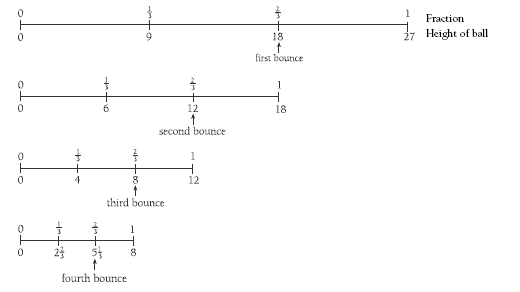
Progressive double number lines could also be used to solve this problem:
Problem Three
The best strategy is to build up a table, systematically starting with the largest coins and working downwards.
Using one 50 cent coin, you need five more coins to make a total of six. The only way to make the additional 25 cents with five coins is to use 5 cent coins. Working systematically in this way, there are three possible answers: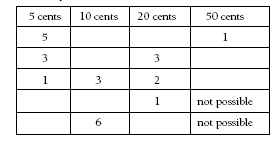
Problem Four
The students need to think about the different ways of making a rectangular, eight-square chocolate block. They will find that there are only two ways: 2 x 4 or 1 x 8 rectangles. It is not possible to get a single square by snapping a 2 x 4 block along one crease, but it is by snapping a 1 x 8 block. You can also get every other number of squares from 1 to 7 inclusive by snapping along one crease.
Hints for Students
1. Try working backwards. If that doesn’t help, try using a table and being
systematic through trial and improvement.
2. Try drawing a diagram.
3. Try using a table, being systematic, trial and improvement, or working backwards.
4. What different-shaped rectangular chocolate blocks of eight pieces could you make? Try drawing a diagram.
Answers to Problems
1. 32
2. 5 1/3 m
3. Three ways, as shown in the following table: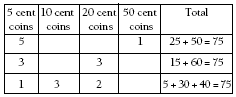
4. The only possible rectangular design is an 8 x 1 block.