
This problem solving activity has a measurement focus.
Tim is storing his little brothers' playdough in a plastic tennis ball tube.
Three balls of playdough, each the size of a tennis ball, fit in neatly.
Tim wonders if he squashes the playdough, how many more playdough balls can fit in the tube.
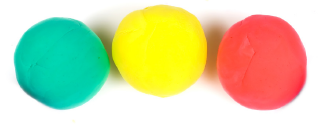
- Compare the volume of a sphere and a cylinder by measuring or applying a formula.
- Devise and use problem solving strategies to explore situations mathematically (be systematic, make a model).
It would be useful to explore the Tennis Ball Tubes problem first.
In this problem students estimate an amount of empty space. They may find this challenging as empty space can be deceptive.
Students may choose to solve the problem by making a physical model and carrying out precise practical measurements of volume, by making a mathematical model, or by doing both to confirm or prove their solution.
- Copymaster of the problem (English)
- Copymaster of the problem (Māori)
- Measuring jug
- 3 playdough balls the size of tennis balls
- Tennis ball tube (preferably a commercially-made one)
The Problem
Tim is storing his little brothers' playdough in a plastic tennis ball tube. Three balls of playdough, each the size of a tennis ball, fit in neatly. Tim wonders if he squashes the playdough, how many more playdough balls can fit in the tube.
Teaching Sequence
- Show the students a playdough ball and ask:
What mathematics can we apply to this ball? - Illustrate the problem with a tube and the 3 playdough balls.
- Ask students to estimate the number of extra balls that could be squeezed into the tube.
Why did you estimate that? - Allow groups time to invent and carry out a method for solving the problem.
- Questions that can help the students get started include:
What information do you know?
What mathematical knowledge could you apply to this problem?
What can you tell me about the amount of space that a ball takes up? (volume) - As the students work ask questions that focus on their use of volume formulae:
Can you tell me how you worked out the volume of the tube? Why does that make sense?
How are the volume of the cylinder and the sphere different? - Ask the students to write a statement to accompany their solution describing the mathematics that they used to solve the problem.
- Share solutions
Solution
Two methods of solution are given.
The first way is the practical way. Students should use a tube of tennis balls to calculate the actual dimensions, or construct a tube of their own.
Method 1: Make a (concrete) model.
To find the volume of the tennis tube, fill it with water then measure the amount of water using a measuring jug. You could find the volume of the ball by wrapping it in plastic and immersing it in water and measuring the amount displaced. Or a ball could be squashed to fit tight in the bottom of the tube and then measure how much of the cylinder is full. How many squashed balls will fit?
Method 2: Make a (mathematical) model.
Let the radius of a playdough ball be R. Then the height, h, of the cylinder is 6R and its radius, r, is R. (We assume that the thickness of balls and tube are negligible). So the volume of the tube (cylinder) is πr2h = π6R3 = 6πR3.
The volume of a sphere is 4/3 π>r3. So the volume of a tennis ball is 4/3 πR3, and the volume of three of them is 3(4/3 πR3) =4πR3.
Hence the volume of empty space is 6πR3 - 4πR3 = 2πR3. So the number of extra tennis balls that could be fitted in is 2πR3/4/3 πR3 = 3/2. So there is a lot of space unfilled in a tennis ball tube. Calculations show that you could get in another one and a half balls in the tube.