
In this unit students are encouraged to further develop part/whole mental methods by using the strategy of "make a ten". This unit follows on naturally from the Smart Doubling unit.
- Recall all pairs of single digit addition facts whose total is 10 or less.
- Use the mental strategy "make a ten" for addition problems.
- Use the most efficient mental strategy for a given problem.
In this unit students are encouraged to use the "make a ten" strategy when solving addition problems. This is demonstrated in the following examples:
- The students work out 8 + 5 by removing 2 from the 5 to leave 3, add this 2 to the 8 to make 10 then add the 3 to the 10 to give 13.
- The students work out 38 + 8 by removing 2 from the 8 to leave 6, add the 2 to the 38 to give 40, then add 6 to the 40 to give 46.
It is desirable for students to move to part/whole methods as counting methods fail for larger numbers. For example, solving 36 + 46 by counting is likely to be tedious and inefficient. However, a part/whole thinker might could solve this by adding 30 and 40 to give 70, then add 6 and 6 to get 12 then add 12 to 70 to get 82. The use of this strategy is likely to be more efficient, especially as the numbers students operate on become larger and more complex.
Students who have successfully understood the part/whole methods in the Smart Doubling unit will have little trouble learning the make a ten part/whole strategy.
The learning opportunities in this unit can be differentiated by providing or removing support to students and varying the task requirements. Ways to support students include:
- introducing fun names for compatible numbers to 10 to encourage engagement. For example, call them 'love’ pairs. 8 loves 2 because they make the special number 10. Numbers can only be with a partner that helps them make 10
- varying the presentation of 10 frames. Children become used to seeing them vertically or horizontally. However, when presented horizontally the frames represent children's left and right fingers
- focussing on equality so children have a clear understanding that 9 + 8 is equal to 10 + 7
- Relating the strategy ‘make 10’ to higher numbers. For example, 8 + 2 = 10, 18 + 2 = 20, 58 + 2 = 60. Have the children notice what is happening to the pattern. What would the answer be to 138 + 2? What would happen if we had 18 + 12 or 58 + 12?
- varying the complexity of the numbers used
- having students create frames for different decades (e.g. 20, 50) and use these in solving more complex problems (perhaps of their own making).
The context for this unit can be adapted to suit the interests and experiences of your students. For example:
- Recall counting in Maori to 10 (or 20). Ask the class if they can count to 10 (or 20) in another language. Kupu such as tāpiri (add) and tango (subtract) could also be be introduced in this unit and used throughout other mathematical learning.
- Make a wall chart with the different ways to say add and subtract in other languages.
- Sets of counters
- Empty tens frames with squares large enough to contain counters
- Tens Frames
Getting Started
- Check the students’ knowledge of addition-to-ten facts (i.e., 1 + 9 = 10, 2 + 8 = 10, 3 + 7 = 10, 4 + 6 = 10, 5 + 5 etc.) This foundational knowledge is built on throughout the course of this unit.
- Check that the students understand the " teen" numbers. For example, show the students a ten and a four on tens frame as shown. They should respond that 10 + 4 is 14 without needing to count-on by ones.

- Pose an addition problem where one of the numbers is just under 10:
Anaru has 9 pink lollies and 6 yellow lollies. How many lollies does he have altogether?
- Ask the students to model this with counters on tens frames.

- Ask the students to think about ways that they could make this problem quick and easy to solve. Encourage the students to think of ways that do not involve counting on by ones.
For example, Anaru moves a yellow lolly to the pink lollies. Now ten and five is shown.
- Draw attention to the answer to 9 + 6 being the same as the answer to 10 + 5. Without this realisation students will not be able to make progress into mental number processes. Although the problem can be solved by counting-on, the aim of this unit is to encourage the development of part/whole mental strategies.
Exploring
Over the next 3-4 days encourage students to use make-to-ten strategies for solving number story problems. You might change the contexts reflected in these problems to better respond to your students' cultural backgrounds, interests, and to make connections with learning from other curriculum areas. At the end of each session provide time for reflection and sharing. Encourage students to share and discuss their answers, strategies, diagrams, and questions as pairs, groups, and a whole class. As an extension you could have students create simple presentations (e.g. as a poster, slide deck, animated video) that demonstrate their learning. These could be used as revision aids by other students.
- Using a relevant context, work with students to make up number stories for 9 + 7, 5 + 8, 9 + 8, 7 + 6. You could make up one problem as a class, then have pairs of students create two problems, before finally having students make up one problem on their own. Model using, and encourage students to use, counters on empty tens frames and the technique of filling up one frame to show ten counters.
- Provide students with the the pre-printed tens frames and have them use these to solve the following problem (or an adapted version):
Moana has 7 oranges and 9 apples. How many pieces of fruit does she have altogether?
Ask the students to show 7 + 9 with a pre-printed 9 card and a pre-printed 7 card. Encourage students to not use counters in solving this problem. The action of imaging pushes the student towards understanding the movement of numbers around within a problem as a key to mental processing.
Ask students to share their thinking with a partner, and then tell you how to solve the problem. Look for students to tell you to move 1 out of the 7 to leave 6, and add 1 to the 9 to create 10.
- Next, have only you, as the teacher, have the pre-printed tens frames. Hold the cards so that only you can see the dots and the students have to visualise what you are seeing. Prior to giving the students addition problems ask the students to first visualise single numbers.
I can see the 8 card. What does it look like?
Some students will "see" the 5 + 3, others will "see" the two spaces.
You could have students draw the relevant tens frames on whiteboards to demonstrate their understanding.
- Next pose addition problems, which encourage the students to visualise the tens frames that only you can see. For example:
I can see 8+ 6. How could I move the dots to work out 8 + 6?
- The next step in the progression involves no materials. The students visualise the tens frames to move around dots as they solve problems:
8 + 5, 3 + 9, 8 + 9.
- Now link the doubles to the make a ten strategy. Ask the students to consider all the ways they know to work out 8 + 9. The range of likely responses is:
- Double 8 + 1 = 16 + 1 = 17
- Double 9 – 1 = 18 – 1 = 17
- Double 10 – 1 – 2 = 20 – 1 – 2 = 19 – 2 = 17 (Rarely used)
- 10 + 8 = 18 but this is 1 too many so the answer is 17
- Remove 1 from the 8 and add 1 to the 9 and to give 7 + 10 which is 17
- Add 2 to the 8 and remove 2 from the 9 and to give 10 + 7 which is 17
After working through this example together students work in pairs to solve: 6 + 8, 9 + 7, 6 + 9. They discuss their strategies.
- Turn students' attention to using make-a-ten strategies to solve subtraction problems. The following subtraction problems use one number within the teen decade.
Michael has 13 lollies and he eats 5 of them. How many lollies does Michael now have now?
Students model 13 on pre-printed ten frames.
Two equally good methods are likely.
- EITHER remove the 3 to leave the 10 then remove a further 2 to leave 8.
- OR remove 5 from the 10 to leave 5 and add the 3 to give 8.
- Have students use pre-printed tens frames to solve number stories for subtraction problems. Use: 14 - 6, 17 - 8, 12 - 8, 17 - 5, 13 - 5, 13 - 7, 14 - 3.
Notice the presence of subtractions like 17 - 5. They prevent the development of the mindset that making-a-ten is always appropriate. In fact, in this example, breaking the ten is not necessary because 7 - 5 = 2 and add the 10 back in gives 12.
- Now work on using a strategy that involves solving subtraction problems by adding.
What is 13 - 9?
Charlotte thinks of a way to work out 13 - 9 by adding. She asks "9 and what makes 13?" and comes up with the answer 4.
Ask the students how they think Charlotte does this. (She has gone 9 + 1= 10, she remembers the 1, she goes 10 + 3 = 13 and adds the 1 to the 3 to get 4.)
Have the students use Charlotte’s addition method to work out these problems: 12 – 9, 14 – 8, 17 – 14, 16 - 7
- Have students explore both ways they have learnt to solve subtraction problems by using either an addition and a subtraction way to work these problems: 13 - 9, 13 - 4, 17 - 15, 17 - 2, 19 - 17 , 12 – 8.
Dear families and whānau,
Recently we have been learning to solve addition and subtraction problems using a strategy called "Making Tens". You can help your child by asking them to explain their thinking as they solve the problems on this sheet.
Making Tens
To work out 9 + 7 Moana removes 1 from the 7 to leave 6 and adds this 1 to the 9 to make 10. She then knows 9 + 7 = 10 + 6 so the answer is 16.
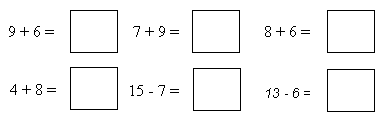
Use Moana’s method of making a ten to work out these:
 |
To work out 9 + 8 William knows a number ways.
- His first way is 9 + 9 = 18 and remove 1 to give 17
- His second way is to remove 1 from the 9 to leave 8, then add 8 and 8 to give 16, then put the 1 back to give 17.
- His third way is to remove 1 from the 8 to leave 7, then add that 1 onto the 9 to make 10. Adding the 10 and the 7 makes 17.
With your child, write stories and draw pictures (diagrams) to show two different ways to work out the following:
9 + 7
Story One:
Story Two:
15 - 9
Story One:
Story Two: