
This problem solving activity has an algebra focus.

Ben has a box with a number in it that is greater than 7.
Moana has a box with a number in it that is less than 9.
Tom has a box with a number in it that is greater than 5.
They all have the same number. What is it?
- Use the < > = symbols to describe relationships.
Equations (statements of equality) that use the symbol = are often familiar to students. Statements of inequality that use the symbols < (less than) and > (greater than) may be less familiar.
This problem explores statements of inequality and the ways these are recorded using symbols. The problem itself may not be numerically challenging for your students, however understanding relationships and expressions between numbers is an important aspect of algebra. The number line representations of the inequality expressions shown in the solution make the relationships evident.
- Number tiles (1-10)
- Copymaster of the problem (English)
- Copymaster of the problem (Māori)
The Problem
Ben has a box with a number in it that is greater than 7.
Moana has a box with a number in it that is less than 9.
Tom has a box with a number in it that is greater than 5.
They all have the same number. What is it?
Teaching Sequence
- Write the symbol = and have your students explain its meaning. (The number or expression on one side of = has the same value as the number or expression on the other side. This makes a statement of equality, or an 'equation'). Record your students' responses.
- Have students suggest some equations. Record these and read them using the words, '........is equal to......'
- Write these symbols: 3, 4, 7, <, >, 1 and support your students to write and read some expressions using these. If necessary, explain what < and > mean ('the alligator eats the number that is greater' can be a useful saying to help children remember the meaning of the symbols).
Eg. 3 < 4, "three is less than 4". - Discuss the ways in which these symbols express inequality.
Which number is greater?
What symbol do we use to show that the number is greater? (e.g. 3 < 4).
How would we write this expression using the less than symbol? (e.g. 4 > 3). - Pose the problem and allow students to work on it independently, or in pairs.
- As the students work on the problem ask questions that focus on the use of the inequalities.
Could you write a statement for the first clue?
Can Ben can have 6 in his line? Why?
Which number is present on each line? How do we know? - Share solutions including the ways in which students have recorded.
Extension
Make up your own 3 clue problems for others to solve. The solution to these will be dependent on the problems posed. Look for students to use the < > symbols correctly.
Solution
Students should recognise the following facts: Ben's number can be any number that is greater than 7, Moana's number must be less than 9, and Tom's number number must be greater than 5. Present each student's statement on a number line:
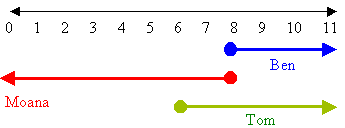
Comparing two lines, we notice that only 6 is on both Tom's line and Moana's line.
The number lines clearly show 8 is the number that satisfies all of the inequalities. It s greater than 5 and 7, but less than 9.