
In this unit we develop the concept of angle and see that an angle may be constructed in a clockwise or anticlockwise direction. In turn, we see the effect of clockwise and anticlockwise turns on objects. We also think about corners of objects that are equivalent to quarter turns and about about whether a corner can be a half turn. These ideas are explored physically.
- Understand clockwise and anticlockwise directions.
- Understand that quarter half turns may begin from any direction.
Angle can be seen as and thought of in at least three ways. These are as:
- the spread between two rays
- the corner of a 2-dimensional figure
- an amount of turning.
The final one of these underpins the others and leads on, naturally, to a definition of degree and the ability to measure angles with a standard unit. This allows students to apply their knowledge of angle in a variety of situations.
We see angle as developing over the following progression:
- Level 1: quarter and half turns as angles
- Level 2: quarter and half turns in either a clockwise or anti-clockwise direction angle as an amount of turning
- Level 3: sharp (acute) angles and blunt (obtuse) angles right angles degrees applied to simple angles – 90°, 180°, 360°, 45°, 30°, 60°
- Level 4: degrees applied to all acute angles degrees applied to all angles angles applied in simple practical situations
- Level 5: angles applied in more complex practical situations
The concept of angle is something that students develop gradually over a number of years. As their understanding matures, they will be able to apply it in a range of situations including giving instructions for directions and finding heights. At a secondary school level, angle is used extensively in trigonometry to measure unknown or inaccessible distances.
Outside school and university, angle is something that is used regularly by surveyors and engineers, both as an immediate practical tool, and as a means to solve the mathematics that arises from practical situations. Therefore, angle has many important applications in the ‘real’ world. Angles play a fundamental role in mathematics and its application.
The learning opportunities in this unit can be differentiated by providing or removing support to students and varying the task requirements. Ways to support students include:
- providing additional practice for children to move themselves and objects in quarter and half turns
- using the hour hand on clocks to practise half and quarter turns. Show a clockwise half turn from 12. Where does it finish? Do the same for fourth/quarter turns.
- varying the activity by placing North, South, West and East on the outside of the rectangle and ask the children questions such as, "if Jorge was facing Mike what direction would he face if he did a half turn?"
- strategically organising students into groups to encourage peer learning, scaffolding, and extension.
The context for this unit can be adapted to suit the interests and experiences of your students by, for example:
- asking children for appropriate words from their home language for half turns, fourth/quarter turns, clockwise and anticlockwise
- using examples from the school playground or other familiar places. "If I am at the top of the slide facing towards the school office, and turn a quarter turn clockwise, what am I looking at?"
- exploring the sport interests of the children through clockwise and anticlockwise turns (e.g. in basketball, netball, badminton)
- exploring the angles involved in making sound from a purerehua (Māori traditional music instrument). Sound is made by twirling the instrument in anti-clockwise action.
Te reo Māori kupu such as koki (angle), huri (turn), hauwhā (quarter), and haurua (half) could be introduced in this unit and used throughout other mathematical learning. You could also encourage students, who speak a language other than English at home, to share the words related to angle and turn that they use at home.
- Copymaster 1
- Art equipment
Session 1
- Revise/introduce the ideas of quarter and half turns. You might use ideas from Turns, Level 1. This can be shown with a student or a toy turning.
- Ask three volunteers to stand at the front of the class and point their arm in some direction. Ask them to make a quarter turn without looking at the other two students. (If appropriate, you might like to heighten the dramatic impact of this by blindfolding the students.) With any luck some students will make their turns clockwise and the others anticlockwise. (If this does not happen automatically you may need to ask them if they can make a quarter turn another way.)
- Discuss the difference between the two types of quarter turns. Write the words clockwise and anticlockwise on the board and get all students to demonstrate turning each way.
- Ask the three students to make a quarter turn in a clockwise or anticlockwise direction. Mark where the students are pointing.
Can they reach the same point if they used the other kind of quarter turn? (Yes)
How many quarter turns of one type will be the same as a quarter turn of the other type? (Three)
What happens with half turns? Is a half turn of one type (e.g. clockwise) equal to three half turns of the other type (i.e. anticlockwise)?
Ask students to discuss and explore this in pairs and report back to the whole class. Look for students to explain why the two half turns are the same.
- Ask students to think of times ("contexts") in which it might be helpful to have names for the direction of our turns. Generate a list of contexts (e.g. sport, orienteering, construction etc.)
Can you imagine times when it would be really important for people to know whether they needed to turn this way or that way?
Refer back to the terms clockwise and anticlockwise. Explain that we call the turn that goes in the direction that the clock goes, the clockwise direction. The other direction is the anticlockwise direction. Agree on a shared definition and write these on the chart. You might draw a diagram as well.
- Get the students to investigate, on their own or in pairs, the link between clockwise quarter turns and anticlockwise quarter turns. Handout A2 sheets with a circle divided into fourths/quarters. Have children select a vehicle (any toy that has a clearly defined front and back) to place in the centre facing towards 12 o'clock. Turn the vehicle a quarter turn clockwise and mark where it finishes. Put F to show where the front of the car now faces, and B to show where the back of the car now faces. Return the vehicle to the centre and move it 3 quarter turns anti-clockwise. Mark where it ended. It should end up in the same position as the clockwise quarter turn ended. Consider your students' knowledge of turns and the terms clockwise and anticlockwise, and what supports will therefore be necessary for students to complete this task. You might model the initial turns in this process, model the whole process, allow students to complete the task independently, or work with some students - providing more support - whilst other students work in pairs or on their own.
- Write the following questions on the board for students to consider during their exploration:
How many clockwise quarter turns is the same as one anticlockwise quarter turn?
How many anticlockwise quarter turns is the same as one clockwise quarter turn?
- Gather the students together to discuss their results. Write the results on the chart.
Session 2
- Draw a rectangle in the playground (or use a small rectangle in class). Have four students stand on the corners of the rectangle (or put four toys on the small rectangle).
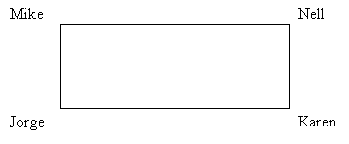
- Have the student in the top left corner (Mike in the diagram) look at the student in the bottom left corner (Jorge). What turn would Mike need to make in order to be looking at Jorge?
Have the student in the bottom left corner Jorge look at the student int the top left corner (Mike). What turn would Jorge need to make in order to be looking at Mike?
Repeat with the students in the other corners. Use the following prompts and questions to develop students' thinking.
- Have Mike look at Nell.
Who will Mike be looking at if he makes a quarter turn clockwise?
Who will Mike be looking at if he makes a quarter turn anticlockwise? - Have Jorge look at Karen.
Who will Jorge be looking at if he makes a quarter turn clockwise?
Who will Jorge be looking at if he makes a quarter turn anticlockwise? - Have Karen look at Jorge.
In what two ways can Karen turn to look at Nell? - Have Jorge look at Karen.
In what two ways can Jorge turn to look at Mike?
- Organise the students into groups of four. Have them to stand in a square and make up their own questions about clockwise and anticlockwise turns. For extension you could ask students to repeat this activity with another shape (e.g. triangle, octagon etc.)
- Have the students return to the mat. Allow different groups to ask the rest of the class the questions that they had made up.
- Summarise the results of the discussions.
Session 3
- It’s not just people that we can turn in clockwise or anticlockwise directions.
Look at the long thin rectangle in this diagram.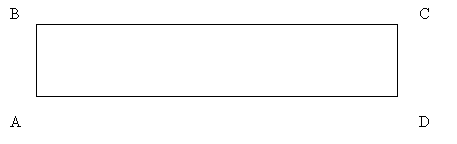
Let the children study the rectangle first. Focus on the letters and their position on the rectangle.
- Ask the students to close their eyes. Then ask a series of questions like the ones below. After each question let them open their eyes and tell you what they think will happen.
What happens to the rectangle if we turn it through a clockwise quarter turn about A?
What happens to the rectangle if we turn it through a clockwise half turn about A?
What happens to the rectangle if we turn it through an anticlockwise quarter turn about B?
What happens to the rectangle if we turn the rectangle through an anticlockwise half turn about C?
- Give the students Copymaster 1 and ask them to draw the result of some turns on the rectangles on that sheet. To produce the turns, roll a dice twice. The first roll will give you the direction of the direction (clockwise for even numbers and anticlockwise for odd numbers). The second roll will give you the amount of turn (half turn for even numbers and quarter turn for odd numbers). Do this activity for each of the six shapes in Copymaster 1.
- Ask the class to show their answers after every ‘turn’.
Session 4
In this session get the class to make up a piece of art using different rotations of one rectangle. They should colour in the rectangles they produce so that:
- the ones that are clockwise quarter turn rotations should be coloured red
- the ones that are anticlockwise quarter turn rotations should be coloured blue
- the ones that are clockwise half turn rotations should be coloured green
- the ones that are anticlockwise half turn rotations should be coloured yellow.
Session 5
- Get the class to talk about quarter and half turns. Use questions such as
What kinds of turns have we been talking about this week?
How would you describe a clockwise quarter turn?
An anti clockwise half turn?
What happens to a rectangle when you give it an anticlockwise quarter turn about a corner?
What happens to a rectangle when you give it a clockwise half turn about a corner?
What is an anticlockwise quarter turn equal to? (Three clockwise ones.) - Play ‘Simon says’ using clockwise and anticlockwise quarter and half turns.
Dear families and whānau,
This week we have been looking at clockwise and anticlockwise turns. Please help your child draw the path they take to school. They should document the turns along the way. If you have a very long trip to take, just document the first part or last part of the journey.